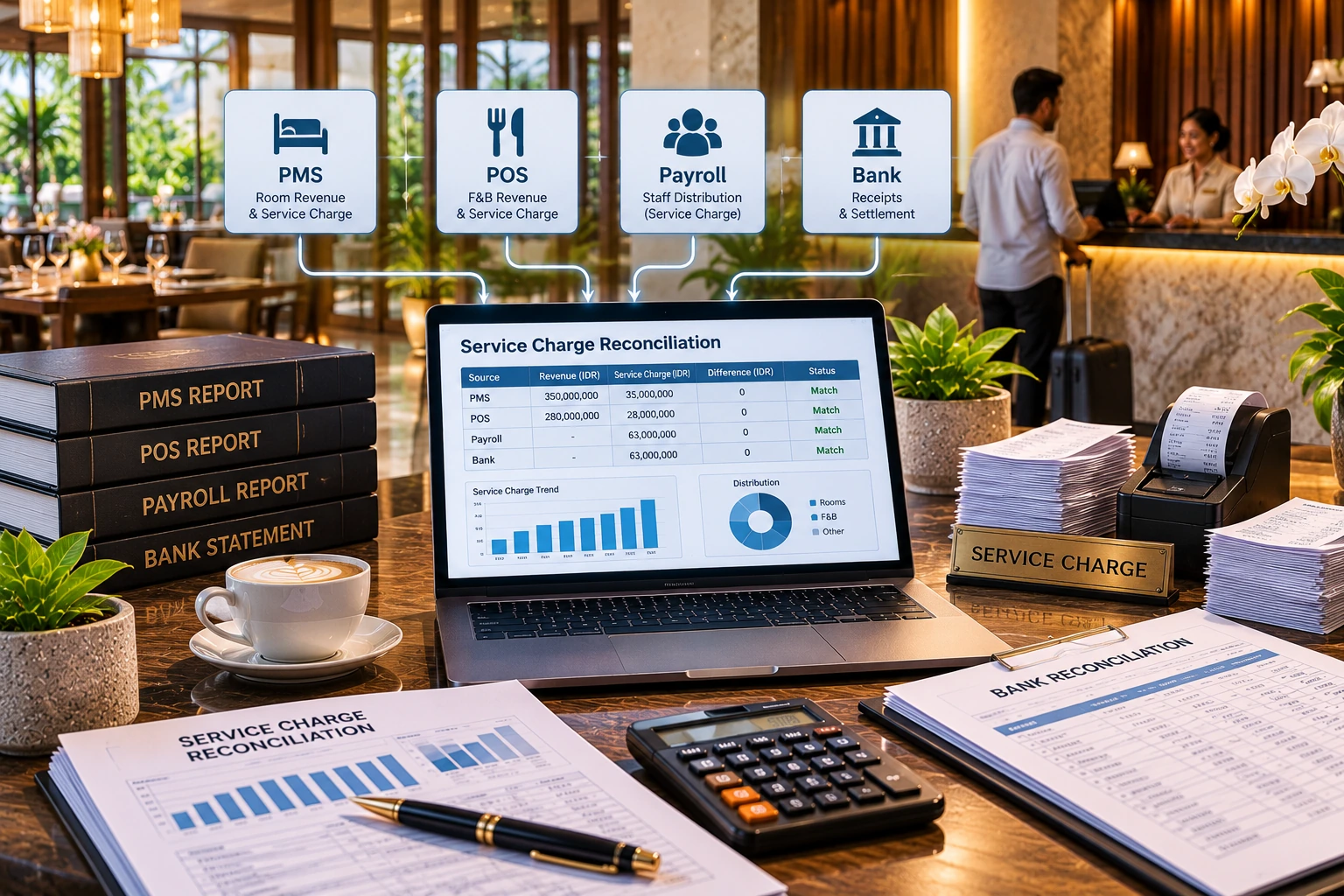
Hotel Service Charge Reconciliation: PMS, Payroll and Bank
Main topic: Tracing service charge differences across PMS, POS, general ledger, payroll and bank records.
Complete foundation: Hotel and Villa Accounting: A Hospitality Finance Systems Guide.
Continue as needed: Hotel Service Charge Journal Entries: Control Accounts and Corrections, Outstanding Hotel Service Charges: Tracing Balances and Aging.
Assistance is available through hospitality bookkeeping and accounting services.
Hotel service charge reconciliation is needed when PMS or POS figures differ from the general ledger, distribution list, payroll or bank account. The solution is to build a trail from guest transactions to worker payments and assign each difference a status before making correction entries.
A sound reconciliation answers four questions: how much was billed, collected, allocated and actually paid.
Hotel Service Charge Reconciliation Starts with One Data Flow
Service charge may pass through several systems. The PMS records room transactions, the POS records outlets, accounting maintains the general ledger, HR holds distribution and payroll lists, and the bank shows actual payments.
If each system closes without a bridge, differences may only become visible after balances accumulate.
Separate billed and collected amounts
Service charge on a guest folio does not always equal the amount collected. Card settlements, corporate accounts, refunds, voids and month-end transactions can create timing differences.
For the reconciliation basis, the manpower regulation states that service charge can only be taken into account after it has been collected.
Working papers should therefore separate billed and collected columns.
Separate allocation, payroll and payment
Collection is not the final stage. Finance still needs to distinguish:
- Amounts allocated.
- Amounts on the distribution list.
- Amounts processed in payroll.
- Amounts paid through the bank.
- Balances still outstanding.
Combining these figures makes the cause of differences difficult to identify.
Service Charge Management Rules Affecting Reconciliation
For hotels and restaurants within hotels, Minister of Manpower Regulation 7 of 2016 remains in force and governs service charge management.
For reconciliation, an important requirement is that service charge management before distribution is separate from company operations.
The same regulation requires written monthly announcements of collection and management results before distribution.
Finance should show these percentages in a traceable collection-to-distribution bridge rather than only a month-end entry.
Seven Critical Differences in Hotel Service Charge Reconciliation
1. PMS or POS differs from the general ledger
Start by mapping transaction codes. Check whether every PMS/POS service charge enters the correct account and whether manual entries lack operational sources.
2. Billed amounts differ from collected amounts
Do not immediately treat this as an error. Separate settlement timing, guest or corporate receivables, refunds and adjustments.
3. Collections differ from the allocation basis
If allocation uses unreconciled figures, every later stage will differ too. Finalise the collection figure before calculating distributions.
4. The 3%-2%-95% allocation differs from the working paper
Check the calculation basis and rounding. The working paper must show the starting figure and each component so the result can be recalculated.
5. Distribution lists differ from payroll
Differences may arise from worker data changes, prior-period corrections or items not yet processed in payroll. Assign each variance a status instead of using one balancing entry.
6. Payroll differs from the bank
Calculated payroll does not mean every amount has been paid. Match payment batches, payment dates, bank returns and pending transactions.
7. The closing balance contains old transactions without details
Separate historical balances from current-month movements. Otherwise finance cannot determine whether the current-period reconciliation is already correct.
The PMS, POS, General Ledger, Payroll and Bank Reconciliation Workflow
Use this sequence as a monthly control:
- Extract PMS and POS service charge reports.
- Identify voids, refunds and adjustments.
- Determine the amount billed.
- Match settlements to determine the amount collected.
- Match collections to the general ledger.
- Calculate the 3%, 2% and 95% allocations.
- Match the workers’ portion to the distribution list.
- Match the distribution list to payroll.
- Match payroll to bank payments.
- Calculate the closing balance and classify all outstanding amounts.
For period controls, service charge collected during a calendar month, after permitted uses, must be distributed to eligible workers no later than the following calendar month.
This makes aging important. Balances extending beyond the following period need clear causes and actions.
Example Service Charge Difference Matrix
This table is an internal control tool rather than a mandatory regulatory format.
| Reconciliation Point | Difference | Possible Cause | Action |
|---|---|---|---|
| PMS/POS vs GL | xxx | Account mapping or manual entries. | Trace transaction codes. |
| Billed vs collected | xxx | Settlements, receivables or refunds. | Separate timing differences. |
| Collections vs allocation | xxx | Basis not finalised. | Recalculate the working paper. |
| Allocation vs distribution list | xxx | Adjustments or rounding. | Review the distribution sheet. |
| Distribution list vs payroll | xxx | Worker or period corrections. | Reconcile payroll data. |
| Payroll vs bank | xxx | Pending or returned payments. | Check payment batches. |
| GL vs closing balance | xxx | Historical balances. | Prepare aging and trace sources. |
Every variance should have a status, responsible person, period and supporting documents.
How to Handle Historical Balances
Do not mix old balances with current-month transactions.
Prepare period-based aging and separate at least:
- Balances with complete documents.
- Balances arising from timing differences.
- Balances related to payroll or payments.
- Balances needing further tracing.
- Balances without adequate documents.
Do not immediately write off undocumented balances. Record the evidence limitations and review according to materiality and company policy.
This lets finance close current-period reconciliation without concealing historical issues.
How Reconciliation Connects to Payroll and PPh 21
At payroll stage, Regulation 7 of 2016 states that employers withhold income tax on service charge when distributing it to workers.
For payroll tax reconciliation, PMK 168 of 2023 has applied since 1 January 2024, governing withholding on individuals’ employment, service and activity income.
Distribution lists, payroll and tax documents therefore need figures that connect. This article does not prescribe one PPh 21 calculation for all workers because actual calculations require the relevant recipient data.
Documents to Prepare
For reconciliation, prepare:
- PMS and POS reports.
- Guest folios or sales summaries.
- Settlement reports.
- Void, refund and adjustment reports.
- The general ledger.
- The chart of accounts.
- 3%, 2% and 95% allocation working papers.
- Service charge distribution lists.
- The payroll register.
- Bank accounts.
- Payment evidence.
- Opening balance details.
- Historical balance aging.
- Prior-period correction entries, if any.
Use documents for the same period so timing differences do not become mixed with recording errors.
Conclusion
Effective hotel service charge reconciliation goes beyond matching one total. Finance needs a connection from PMS/POS to the general ledger, allocation, distribution lists, payroll and bank.
The sequence is billed amounts → collected amounts → general ledger → 3%-2%-95% allocation → distribution list → payroll → bank → closing balance.
Categorise every difference and assign follow-up. This separates timing differences, mapping errors, payroll issues, pending payments and historical balances before they become mixed in the following month.
Still Unable to Identify a Service Charge Difference?
If PMS/POS, general ledger, distribution lists, payroll and bank cannot be matched in one working paper, begin with the current period and separate it from historical balances.
Usman Tax supports tax and accounting needs for Bali hospitality businesses. Discuss reconciliation and hotel tax reporting through its accounting consultation services.
Read Also: Hotel and Villa Accounting: A Hospitality Finance Systems Guide
FAQ Hotel Service Charge Reconciliation: PMS, POS, Payroll and Bank
What is hotel service charge reconciliation?
It matches PMS/POS service charge to collected amounts, the general ledger, allocation, distribution lists, payroll, bank records and closing balances.
Why can PMS and general ledger figures differ?
Settlement timing, refunds, voids, adjustments, account mapping or manual entries may cause differences. Separate their causes before making corrections.
Can billed service charge immediately be used for distribution?
Regulation 7 of 2016 states that service charge can only be taken into account after collection. Separate billed and collected amounts in the reconciliation.
How should old service charge balances be handled?
Separate historical balances from current transactions, prepare aging by period and classify by documentation, timing, payroll, payments or further tracing needs.
Must the closing service charge balance always be zero?
Do not force it to zero. What matters is a clear source, period, reason and follow-up for every outstanding amount.
Does service charge reconciliation need to connect to payroll?
Yes. Trace the workers’ portion from allocation working papers to distribution lists, payroll and bank payments so differences are found before the next period.
Sources and References
- Service Charge Rules for Hotels and Restaurants in Hotels — jdih.kemnaker.go.id
- Official Minister of Manpower Regulation 7 of 2016 — jdih.kemnaker.go.id
- PPh 21 Implementing Rules for Individual Income — jdih.kemenkeu.go.id
Recommended Next Articles
- Hotel Service Charge Accounting Guide — usmantax.co.id
- Tracing Outstanding Hotel Service Charge Balances — usmantax.co.id