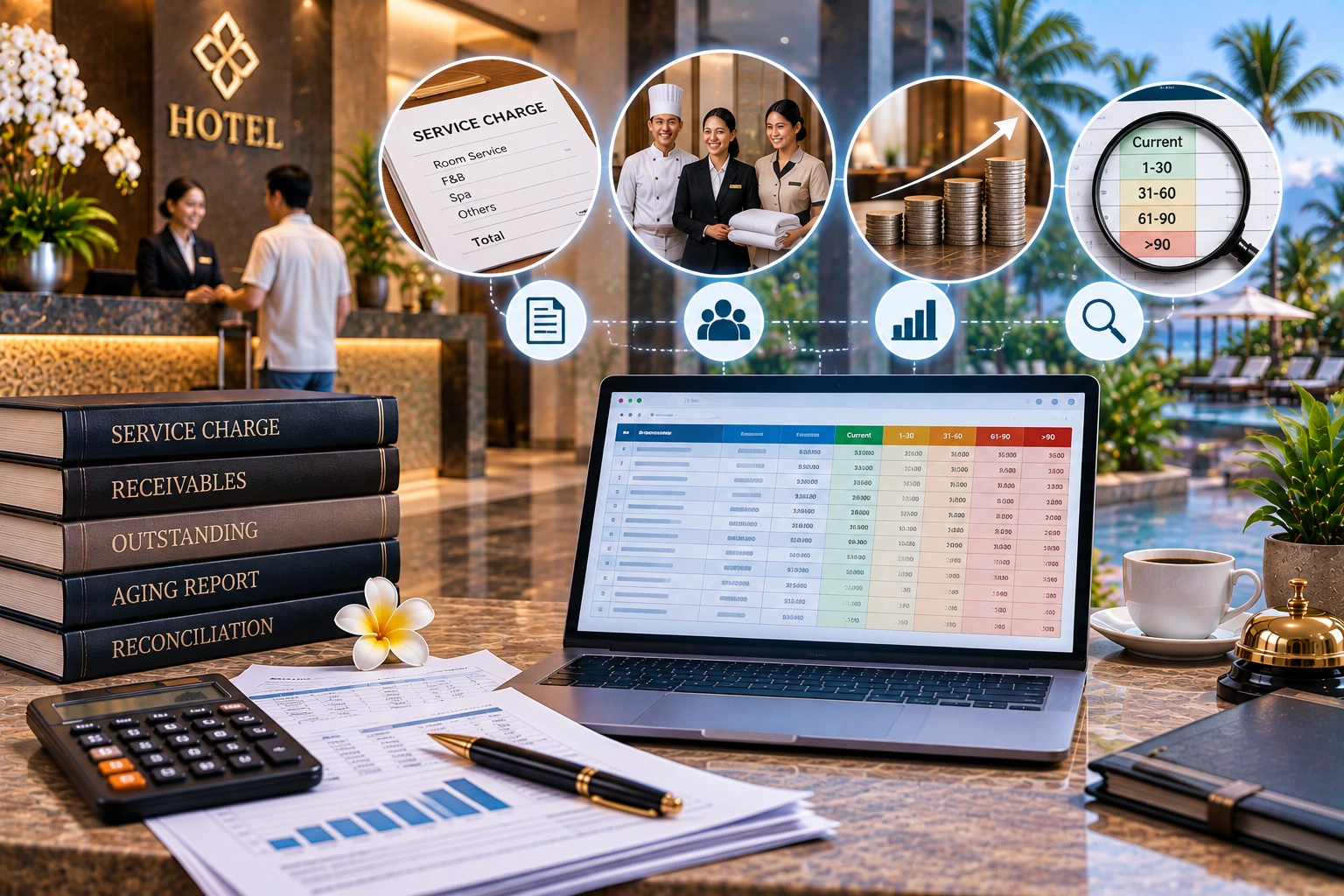
Outstanding Hotel Service Charges: Tracing Unexplained Balances
Main topic: Diagnosing outstanding service charge balances and tracing source documents; age grouping is covered in the aging article.
Complete foundation: Hotel and Villa Accounting: A Hospitality Finance Systems Guide.
Continue as needed: Hotel Service Charge Aging: Age Matrix and Follow-up Priorities, Hotel Service Charge Reconciliation: PMS, POS, Payroll and Bank.
Assistance is available through hospitality bookkeeping and accounting services.
Outstanding hotel service charges remaining after closing do not automatically mean the accounting is wrong. Balances may arise because amounts have not been collected, have been collected but not allocated, have entered payroll but remain unpaid, involve adjustments, or include old opening balances never properly reconciled.
Do not begin by asking which journal entry to make. Start with which transactions created this balance, and what stage have they reached?
Why Do Hotel Service Charge Balances Remain Outstanding?
To trace outstanding amounts, finance must separate service charge movements into stages. A common error is treating the amount billed to guests as identical to the amount collected and ready for distribution.
Distinguish timing differences from unexplained differences
A timing difference may arise when a transaction is recorded at month-end but settlement or receipt falls in the next period. This differs from an amount that cannot be traced to a guest folio, PMS, POS, bank, payroll or payment document.
Internally, assign each balance a status: timing difference, awaiting allocation, awaiting payroll, awaiting payment, adjustment pending or unexplained. This is more useful than viewing only the account total.
Distinguish billed, collected, allocated and paid amounts
These four figures answer different questions:
- Billed: service charge appearing on a guest transaction or bill.
- Collected: amounts actually received or meeting the hotel’s collection basis.
- Allocated: amounts entered in distribution working papers.
- Paid: amounts whose disbursement can be matched to payroll or bank records.
Mixing these statuses makes closing balances difficult to explain because figures from different transaction stages enter one account without a bridge.
The Basis for Hotel Service Charge Controls
For hotels and restaurants within hotels, Minister of Manpower Regulation 7 of 2016 on Service Charges in Hotel Businesses and Restaurants in Hotels remains listed as in force.
For control purposes, the regulation requires separate management from company operations and written monthly announcements of collection and management results before distribution.
The Ministry of Manpower JDIH explains that use comprises 3% for loss or damage risk, 2% for human resource quality improvement and 95% for distribution to workers.
For aging, an important point is that JDIH Kemnaker explains that service charge can only be taken into account for distribution after it has been collected.
Amounts still at the collection stage should therefore not be mixed with amounts already in distribution. Tracking transaction status helps explain why the closing balance is not yet zero.
Seven Steps to Trace Hotel Service Charge Balances
1. Establish the opening balance
Obtain the opening service charge account balance without assuming it is correct. Determine whether it has monthly, outlet, source transaction or unfinished payment details.
Separate prior-year balances from current-period movements so new transactions do not conceal old differences.
2. Extract service charge from the PMS, POS or guest folios
Collect source reports for the period. For multi-outlet hotels, separate rooms, restaurants, banquets, spas or other sources according to the actual system configuration.
The aim is to establish the source amount, not immediately determine the amount to distribute.
3. Reconcile to collections
Match transactions to settlements and receipts. Check credit transactions, corporate accounts, OTA settlements, refunds, voids, cancellations, inter-period transfers and uncollected transactions.
This separates amounts merely billed from amounts already collected.
4. Check adjustments
Adjustments need reasons and documents, such as transaction corrections, late voids, folio changes, prior-period corrections or account reclassifications.
Use a separate adjustment column so the amount is not hidden within total collections or payments.
5. Match the allocation sheet to payroll
Amounts in distribution working papers must be comparable to those ultimately used in payroll. Record whether differences arise from worker eligibility, data corrections, payroll timing or other demonstrable changes.
When distributed amounts enter worker payroll, reconciliation must also connect to income tax administration because PMK 168 of 2023 governs withholding on individuals’ employment, service and activity income.
6. Match payments to the bank
A payroll report or distribution list does not mean the balance has been paid. Match the amount due to transfer evidence or bank records.
If payroll is processed but payment occurs the following month, label it awaiting payment rather than unexplained.
7. Recalculate the closing balance
Use a simple internal bridge:
Opening balance + collections + adjustments − amount settled/distributed = closing balance.
This is a control bridge rather than a universal journal rule. Actual entries must follow the hotel’s chart of accounts and transaction facts.
If the working paper closing balance differs from the general ledger, trace that final difference to entries, source documents or opening balances.
How to Prepare Service Charge Aging
After establishing the closing balance, analyse it by age and cause. The following aging is an internal management tool, not a legal deadline.
| Balance Age | Status to Check | Initial Action |
|---|---|---|
| 0–30 days | Current timing or payroll processing. | Match collection, allocation and payment dates. |
| 31–60 days | Delayed payment or adjustment. | Find working papers and approvals. |
| 61–90 days | Cross-period differences. | Reconcile GL, payroll and bank. |
| Over 90 days | Historical outstanding balances. | Trace source documents and opening balances. |
Aging becomes useful when every row has an owner, cause, supporting documents and next action. An age list without statuses merely moves the general ledger total into another spreadsheet.
Example Reconciliation Working Paper
A working paper need not be complicated, but it must show how the balance moves. Use the following as a starting point.
| Component | Amount | Reference | Status |
|---|---|---|---|
| Opening balance | xxx | Prior-period GL. | Matched / review. |
| Current-period collections | xxx | PMS/POS + bank. | Matched / timing. |
| Adjustments | xxx | Journal support. | Approved / pending. |
| Allocation | xxx | Service charge sheet. | Matched. |
| Payroll | xxx | Payroll register. | Matched / variance. |
| Payments | xxx | Bank. | Paid / outstanding. |
| Closing balance | xxx | GL. | Explained / unexplained. |
Every closing balance must break down into referenced transactions. If an amount is described only as old balance, finance has not completed the reconciliation.
Do Not Immediately Write Off Old Balances
Old balances can make reports difficult to read, but correction entries made without knowing the cause can erase the transaction trail.
Before adjusting, check at least:
- Whether collected amounts remain undistributed.
- Whether payments occurred but were not posted.
- Whether payroll recorded a different figure.
- Whether duplicate postings exist.
- Whether prior-period adjustments are missing.
- Whether opening balances came from a system migration.
- Whether transactions can be traced to bank records or source reports.
If historical documents are incomplete, assign a specific status and document the limitations. Do not present the cause as verified when evidence is unavailable.
When Do Service Charge Balances Need Deeper Review?
Further review is relevant when:
- Balances increase monthly without details.
- Opening balances lack breakdowns.
- The ledger differs from service charge reports.
- Finance and HR use different amounts.
- Payroll has been processed but the account balance does not decrease.
- Bank payments differ from distribution lists.
- The hotel recently changed its PMS, POS or accounting system.
- Historical balances span several periods.
- Adjustments are frequently made without supporting documents.
- The owner cannot explain how much still needs settlement.
The priority is traceability rather than forcing a zero balance. An unsupported zero is no better than an outstanding balance that can be explained.
If tracing identifies account mapping or bookkeeping issues, Usman Tax accounting services includes bookkeeping and transaction recording, financial statement preparation, and financial analysis and consultation.
If balances also affect payroll reconciliation or hotel tax administration, Usman Tax hotel tax reporting services includes financial report reconciliation and operational hotel tax consultation.
Conclusion
Do not assess hotel service charge balances solely by whether the account reaches zero. What matters is whether each balance can be explained by transactions, collection timing, allocation, payroll, payments and adjustments.
Start with the opening balance, separate current movements from historical amounts, prepare aging by age and cause, and connect PMS/POS records, the general ledger, allocation sheets, payroll and bank records. Finance can then determine whether timing explains the balance or whether correction and further review are needed.
Are Hotel Service Charge Balances Difficult to Reconcile?
If opening balances, collections, payroll, payments and closing balances cannot be connected in one working paper, start by mapping balance sources and separating current differences from historical outstanding items.
Usman Tax provides accounting services and tax reporting for Bali hospitality businesses. Consultation can address balance reconciliation, account mapping and documents requiring investigation based on your hotel’s data.
Read Also: Hotel and Villa Accounting: A Hospitality Finance Systems Guide
FAQ Outstanding Hotel Service Charges
Why are hotel service charge balances not zero at every month-end?
Balances may remain because of collection timing, unfinished allocation, unprocessed payroll, unpaid amounts, adjustments or old opening balances. Analyse transaction status rather than only the account total.
Does an outstanding balance mean distribution is late?
The general ledger balance alone cannot establish this. Distinguish uncollected, collected, allocated, payroll-processed and paid amounts before assessing why a balance remains.
How do billed and collected service charges differ?
Billed amounts appear on transactions or bills. Collected amounts have reached collection status according to the hotel’s transactions. Timing differences between them may create temporary balances.
How do you prepare service charge aging?
Separate balances by period or age, then assign causes such as timing difference, awaiting allocation, awaiting payroll, awaiting payment, adjustment pending or unexplained. The 0–30, 31–60, 61–90 and over-90-day groups are internal management tools.
Can old balances be written off immediately?
Investigate the cause first. Check source reports, the general ledger, payroll, bank records, adjustments and opening balances. Document any historical evidence limitations before determining accounting treatment.
What data is needed for balance reconciliation?
At minimum, the general ledger, opening balances, PMS/POS service charge reports, collection or settlement data, adjustment entries, allocation sheets, payroll register, payment evidence and relevant bank accounts.
Sources and References
- Service Charge Rules for Hotels and Restaurants in Hotels — jdih.kemnaker.go.id
- Official Explanation of Hotel Service Charge Collection and Distribution — jdih.kemnaker.go.id
- Income Tax Rules for Individuals’ Employment, Service and Activity Income — jdih.kemenkeu.go.id
- Usman Tax Bali Accounting Services — usmantax.co.id
- Usman Tax Bali Hotel Tax Reporting Services — usmantax.co.id
- Coretax Administration Guide for Bali Hotel Businesses — usmantax.co.id