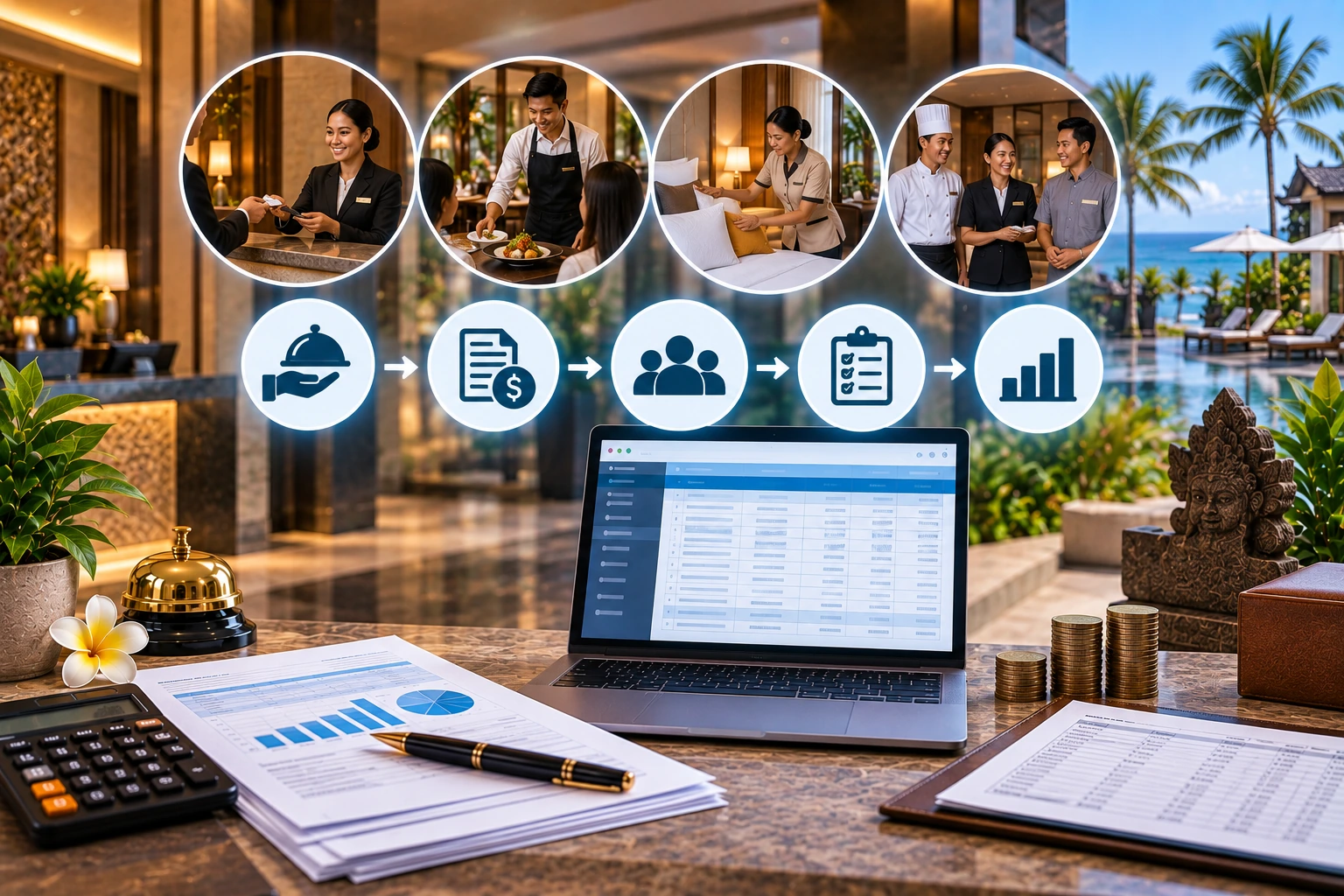
Hotel Service Charge Accounting: Collection to Distribution
Main topic: The core service charge accounting workflow from billing to distribution; journal examples, differences and aging are covered in dedicated articles.
Complete foundation: Hotel and Villa Accounting: A Hospitality Finance Systems Guide.
Continue as needed: Hotel Service Charge Journal Entries: Control Accounts and Corrections, Hotel Service Charge Reconciliation: PMS, POS, Payroll and Bank, Hotel Service Charge Aging: Age Matrix and Follow-up Priorities.
Assistance is available through hospitality bookkeeping and accounting services.
Hotel service charge accounting involves more than recording an extra amount on a guest bill. The hotel must trace how much was billed, how much was collected, how it was allocated, how much entered payroll, how much was paid to workers and what remains at period-end.
Without reconciliation, finance may have different figures in the PMS or POS, bank accounts, general ledger, payroll and worker distribution lists. Structured accounting builds one workflow in which every balance movement has documents and a clear recording basis.
Hotel Service Charge Accounting: Issues to Control
The main issue is usually more than preparing journal entries. The challenge is keeping operational transactions and obligations to workers traceable from the start through payment.
Service charge does not end at the guest bill
When service charge is added to rooms, restaurants, banquets or other outlets, data may pass through the PMS, POS, guest folios, settlements, cash and bank accounts before entering the ledger.
Accounting therefore needs mapping that explains the transaction source, recognition timing, account used, corrections or voids, receipts already collected and amounts still awaiting distribution processing.
Separate collected, allocated, paid and outstanding amounts
Do not mix these four figures:
- Service charge billed.
- Service charge collected.
- Service charge allocated for distribution.
- Service charge paid.
Explain the closing balance as outstanding transactions with an identifiable basis rather than simply a residual general ledger figure.
The Basis for Hotel Service Charge Management
For hotels and restaurants within hotels, Minister of Manpower Regulation 7 of 2016 on Service Charges in Hotel Businesses and Restaurants in Hotels remains in force.
Within that framework, service charge is non-wage income and employers operating hotels or restaurants within hotels may apply a service charge.
The Ministry of Manpower JDIH also explains that its use comprises 3% for loss or damage risk, 2% for human resource quality improvement and 95% for distribution to workers.
During distribution, service charge must be distributed to workers after deducting the permitted loss or damage and human resource development portions.
For accounting, this requires records distinguishing collection, permitted uses, the amount to distribute and actual payments to workers.
Scope of Hotel Service Charge Accounting
The following scope can form a review basis before determining the hotel’s detailed requirements.
| Area | Review | Output |
|---|---|---|
| Transaction mapping | PMS, POS, guest folios, outlets and settlements. | Service charge source map. |
| Chart of accounts | Collection, liability, correction and payment accounts. | An easily reconciled account structure. |
| Reconciliation | Billing, collection, bank and general ledger. | Monthly reconciliation working papers. |
| Allocation | Deduction basis and amount for distribution. | Allocation control sheet. |
| Payroll interface | Amounts entering worker income records. | Accounting-to-payroll reconciliation. |
| Payments | Distribution lists and actual transfers. | Paid-versus-outstanding reconciliation. |
| Closing | Closing balances and unfinished transactions. | Outstanding item list and explanations. |
This structure gives owners more than a monthly service charge total. Management can see transaction origins, collection status, allocated amounts, actual payments and balances still requiring settlement.
Seven Hotel Service Charge Accounting Controls
1. Separate service charge from ordinary operating revenue
Use account mapping that makes service charge independently traceable. The aim is more than adding an account code: it prevents service charge from disappearing within total room, food and beverage or other revenue.
2. Reconcile PMS/POS records to collections
Operational system amounts are not necessarily identical to receipts in the same period. Trace voids, adjustments, refunds, credit transactions, settlements and receipt timing differences.
3. Use a control account for undistributed balances
The hotel should clearly see collected service charge that has not completed allocation or payment. A control account makes the balance reviewable from month to month.
4. Separate deductions before distribution
Maintain dedicated working papers for portions used under applicable policies and rules. Do not reduce service charge solely through an unsupported month-end entry.
5. Reconcile accounting to payroll
When service charge becomes worker income, payroll and tax withholding need to connect to PPh 21 rules because PMK 168 of 2023 governs withholding on individuals’ employment, service and activity income.
Sending HR a total is insufficient. Reconcile the service charge control sheet, the amount used by payroll, any corrections and the amount ultimately paid.
6. Match distribution lists to bank payments
A distribution list is not evidence that payment has been completed. Match approved amounts to payroll or transfer files and bank movements to separate paid balances from outstanding balances.
7. Close the period with a service charge reconciliation
At month-end, prepare one control sheet answering:
Opening balance + collections − allocation/payment/adjustment movements = closing balance.
Use the movements relevant to the particular control account; do not deduct the same funds twice merely because they pass through both allocation and payment.
The closing balance needs an explanation. If balances keep growing without aging or transaction details, accounting loses the ability to explain the actual obligation.
The Workflow from PMS/POS to Payroll
A practical workflow is:
- Extract service charge transactions from the PMS, POS or other operational systems.
- Identify voids, refunds, corrections, credit transactions and settlements.
- Reconcile billed service charge to collected amounts.
- Post to the accounts specified in the chart of accounts.
- Prepare allocation working papers and the amount to distribute.
- Reconcile distributions to payroll data.
- Match payments to bank accounts.
- Review outstanding balances before closing.
Adapt this structure to the hotel’s systems. Hotels with many outlets or collection sources usually need more detailed mapping than a single-source property.
Documents and Data to Prepare
To start the review, prepare data actually used in operations, including:
- The chart of accounts and general ledger.
- PMS and POS service charge reports.
- Relevant guest folios or sales summaries.
- Void, refund and adjustment reports.
- Bank accounts and settlement reports.
- The service charge distribution policy or formula.
- Recipient worker lists and related payroll data.
- Payment evidence or transfer files.
- Opening service charge account balances.
- Existing finance or HR working papers.
This data establishes the current workflow. Do not begin by replacing every account code before identifying the causes of historical differences.
When Does a Hotel Need a Service Charge Review?
A review is especially relevant when:
- General ledger service charge balances keep increasing.
- Finance figures differ from HR or payroll.
- PMS/POS amounts differ from accounting working papers.
- Old outstanding balances lack detail.
- Worker payments are difficult to reconcile to bank records.
- The distribution formula or basis changes without updated account mapping.
- The hotel changes its PMS, POS, payroll or accounting system.
- Management needs service charge reports that are easier to audit.
New hotels can also review before go-live so account structures and working papers exist before transactions accumulate.
Scope Boundaries to Distinguish
An accounting review does not automatically replace all HR, employment, payroll or legal advisory functions. Worker entitlements and formulas must follow employment circumstances and applicable rules, while accounting ensures transactions, balances, allocations and payments are recorded and reconcilable.
For hospitality accounting support, Usman Tax accounting services includes bookkeeping and transaction recording, financial statement preparation, and financial analysis and consultation.
If the review also addresses the relationship between service charge and hotel tax reports, Usman Tax provides hotel financial report reconciliation and operational tax consultation.
Conclusion
Effective hotel service charge accounting lets owners quickly answer three questions: how much was billed, how much is due for distribution and how much remains outstanding.
The key is a consistent connection between PMS/POS records, collections, control accounts, distribution working papers, payroll, bank payments and the general ledger. Service charge then becomes traceable from start to completion rather than a balance that only appears at closing.
Need to Organise Your Hotel Service Charge Accounting?
If PMS, POS, general ledger, payroll and worker payments cannot be reconciled in one working paper, start by reviewing existing account mapping and actual balances.
Usman Tax provides accounting services and tax reporting for Bali hospitality businesses. Consultation can address recording structures, reconciliation needs and the service charge workflow based on your hotel’s systems and transactions.
Read Also: Hotel and Villa Accounting: A Hospitality Finance Systems Guide
FAQ Hotel Service Charge Accounting for Records, Payroll and Reconciliation
Is hotel service charge salary?
Minister of Manpower Regulation 7 of 2016 describes it as non-wage income. When distributed to workers, it still needs to connect to payroll administration and income tax according to the recipients’ circumstances.
Should service charge be recorded separately from room revenue?
Separate account mapping greatly assists internal controls because management needs to trace amounts billed, collected, allocated, paid and outstanding. Adapt the final structure to the hotel’s chart of accounts and accounting policies.
What portion is distributed to workers?
The Ministry of Manpower JDIH explains the allocation as 3% for loss or damage risk, 2% for human resource quality improvement and 95% for distribution to workers under Regulation 7 of 2016.
Why might a service charge balance remain at month-end?
Causes may include collection and payment timing differences, credit transactions, adjustments, payroll corrections, unpaid amounts or old opening balances. Analyse the balance through reconciliation and aging rather than immediately writing it off.
Must service charge accounting connect to payroll?
Yes, where service charge is distributed to workers. Reconcile allocated amounts to payroll data and payments so the ledger, payroll and bank figures can be explained.
What data is needed for a review?
Usually the chart of accounts, general ledger, PMS/POS reports, service charge reports, adjustment data, bank or settlement records, distribution policy, related payroll, payment evidence and opening service charge account balances.
Sources and References
- Service Charge Rules for Hotels and Restaurants in Hotels — jdih.kemnaker.go.id
- Official Explanation of Hotel Service Charge Distribution — jdih.kemnaker.go.id
- PPh 21 Rules for Individuals’ Employment, Service and Activity Income — jdih.kemenkeu.go.id
- Usman Tax Bali Hotel Accounting Services — usmantax.co.id
- Usman Tax Bali Hotel Tax Reporting Services — usmantax.co.id
- Coretax Administration Guide for Bali Hotel Businesses — usmantax.co.id