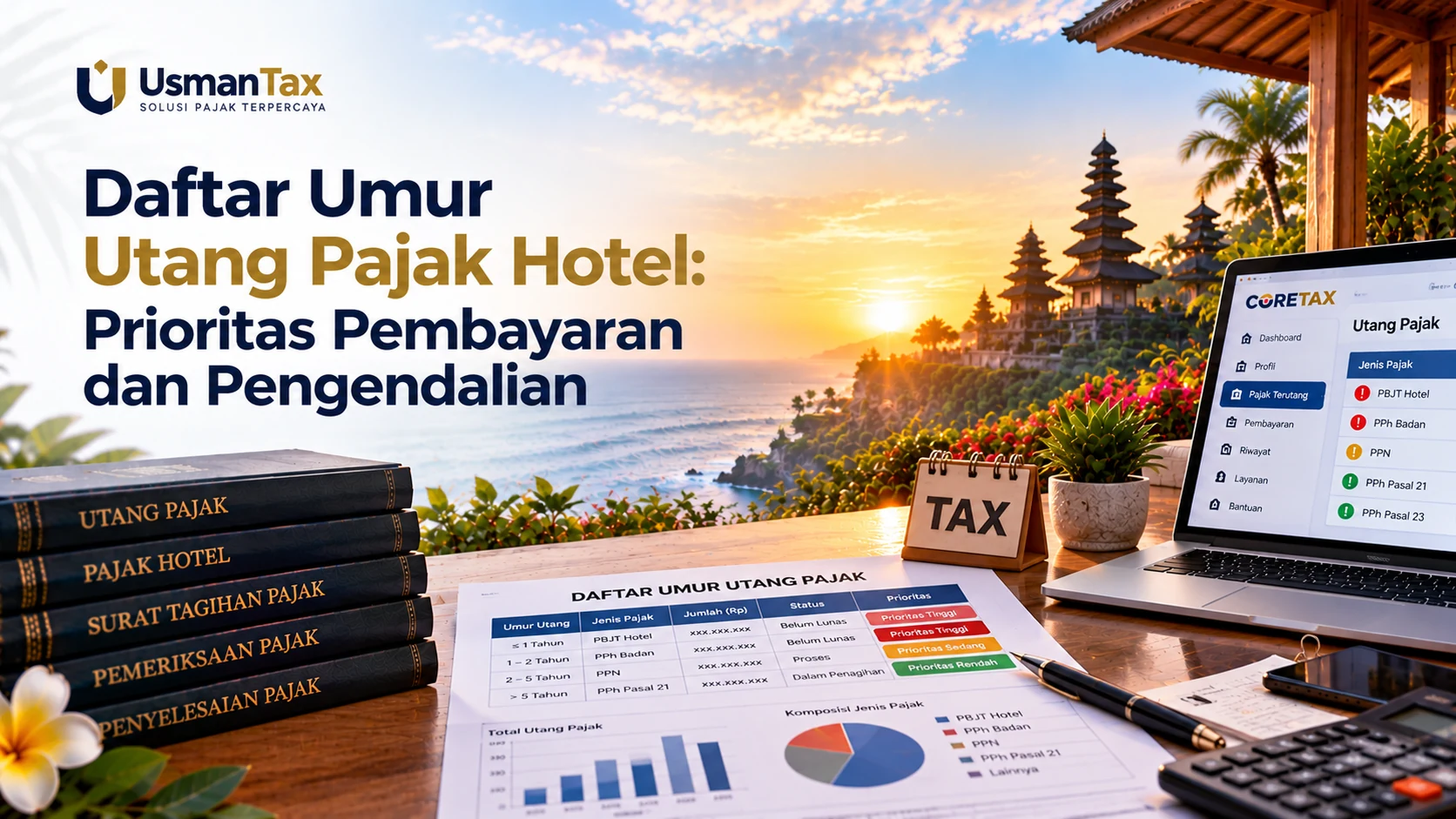



Hotel Tax Payable Aging: Payment Priorities and Controls
A hotel tax payable aging report helps management identify liabilities that are not yet due, overdue or still require review. It connects each tax balance to the obligation type, tax period, due date, payment evidence and resolution status.
In accounting practice, hotel tax payable aging supports action priorities and cash planning. However, an aging report does not replace official tax documents or automatically establish that every recorded balance is an arrear owed to the government.
What Is Hotel Tax Payable Aging?
Tax payable aging groups tax liability balances according to the time elapsed since their due dates, or identifies them as not yet due.
Its purpose is to show liabilities requiring payment, clarification, accounting adjustments or further review.
There is an important difference between the age of an accounting balance and the length of a tax payment delay. A balance recorded 40 days ago is not necessarily 40 days overdue. Days overdue must be measured from the due date applicable to that obligation.
Likewise, tax already paid but not yet posted to the general ledger should not immediately be classified as an actual arrear without checking payment evidence.
Data Needed to Prepare the Aging Report
The hotel’s finance team should collect:
- Tax type and responsible authority
- Tax period or tax year
- Billing document number or obligation reference
- The liability amount in the relevant document
- The general ledger balance
- The verified due date
- Payments already made
- The remaining unsettled liability
- Clarification or resolution status
- The person responsible for follow-up
A company managing several hotels can add property name and tax jurisdiction columns. This prevents one hotel’s obligations from automatically being combined with another property’s liabilities.
Set the review date
The aging report needs a clear reference date, such as 31 October or the monthly accounting close date.
Comparing ages measured on different dates without explanation can mislead readers because balances and overdue periods change over time.
Verify the due date
Do not use one due date for every tax. Check the date by tax type, period, jurisdiction and the relevant assessment or billing document.
If the date cannot yet be confirmed, mark the item as requiring verification. Do not force an overdue figure merely to make the report look complete.
How to Group Hotel Tax Payable Aging
The company can use overdue bands as an internal control tool.
| Band | Internal Criterion | Initial Action |
|---|---|---|
| Not yet due | The payment due date has not passed | Prepare funds and documents |
| 1–30 days | 1 to 30 days overdue | Check the status and prioritise follow-up |
| 31–60 days | 31 to 60 days overdue | Increase review and escalation |
| 61–90 days | 61 to 90 days overdue | Assess obstacles to resolution |
| Over 90 days | More than 90 days overdue | Prioritise handling and review the legal status |
| Requires verification | The date or balance is uncertain | Complete the evidence and obtain confirmation |
These bands are not official penalty categories. They do not mean that legal consequences begin only after 30, 60 or 90 days.
For genuinely overdue obligations, internal days overdue can be calculated as the calendar day difference between the review date and due date. If the result is zero or negative, show the item as not overdue.
The company should also separate arrears by document status rather than only the number of days. A bill subject to active collection may need faster attention than an older balance that has already been paid.
Distinguishing PBJT Liabilities from Central Taxes
Hotels in Bali can have obligations administered by local and central governments. This separation should be visible in the aging report.
PBJT on hospitality services
Indonesia’s local tax framework is regulated by Law No. 1 of 2022 on Financial Relations between Central and Regional Governments.
General local tax administration rules are also set out in Government Regulation No. 35 of 2023.
For a hotel in Badung Regency, a relevant local reference is Badung Regional Regulation No. 7 of 2023 on Local Taxes and Levies.
It has been amended by Badung Regional Regulation No. 8 of 2025, so actual obligations must be determined with the applicable amendments in mind.
For hotels elsewhere, payment dates and settlement procedures must be checked under the rules of the responsible local government. Badung’s requirements should not be treated as applying throughout Bali.
Central tax obligations
A central tax aging report can include corporate income tax, relevant withholding or collection obligations, and tax bills issued by the Directorate General of Taxes (DJP).
According to DJP’s Coretax guidance on creating billing codes for tax bills, users can select the bill to pay and enter a payment amount up to its remaining balance.
DJP provides a billing code service for tax bills relating to legal documents such as bills, assessments, decisions or rulings.
This guidance concerns the central tax system. For local PBJT, use the information and procedures of the local authority administering the obligation.
An Example of a Hotel Tax Payable Aging Report
Suppose accounting prepares a report as at 31 October 2026. The company has several obligations whose due dates have been confirmed through their respective documents.
The following table is an internal simulation, rather than actual liabilities or official dates of general application.
| Illustrative Liability | Due Date | Balance | Days Overdue |
|---|---|---|---|
| Tax A | 20 October 2026 | IDR 12,000,000 | 11 days |
| Tax B | 15 September 2026 | IDR 18,000,000 | 46 days |
| Tax C | 1 August 2026 | IDR 7,500,000 | 91 days |
| Tax D | 15 November 2026 | IDR 10,000,000 | Not yet due |
The illustrative total is IDR 47,500,000, comprising both overdue liabilities and obligations not yet due.
The table shows that Tax C has been overdue the longest, while Tax B has the larger overdue amount.
However, final priorities do not depend on either factor alone. The company also needs to consider collection action, certainty of the amount, administrative risks and available funds.
If a payment has already been made but not recognised in the accounts, correct the report using valid evidence.
Setting Payment Priorities
Hotel cash management must consider tax obligations while still ensuring that bills are correct.
Priorities based on obligation status
Consider several factors together:
- Has the due date passed?
- Is there an official bill or collection document?
- Does the amount agree with the accounts?
- Are there payments not yet allocated?
- Is the company pursuing clarification or an administrative process?
- Are funds available for settlement?
Verified liabilities requiring immediate action should be handled under the applicable rules, including consultation with the responsible authority where needed.
Internal priority rankings do not change legal obligations or extend deadlines.
Priorities based on cash availability
Management can prepare a tax payment forecast alongside the hotel’s expected cash receipts.
For example, list liabilities requiring action this week, next week and in later periods. This helps arrange funding and identify potential cash shortages.
If funds are insufficient for all obligations, do not assume partial payment is available or permitted for every tax. Check the applicable mechanism and contact the relevant authority before deciding.
Monitoring Bills Under Clarification
Differences in an aging report do not all require the same treatment.
Some balances may already have been paid, but accounting has not received the evidence. Other official bills may require checks of the tax type or period.
To avoid decisions based on incomplete data, use the following internal statuses:
| Status | Meaning | Follow-Up |
|---|---|---|
| Verified unpaid | The obligation and remaining amount agree | Prepare settlement action |
| Payment under review | There is an indication of a payment not yet matched | Match evidence and allocation |
| Awaiting documents | Important evidence is incomplete | Request the relevant documents |
| Authority clarification required | Administrative records differ | Request review through official channels |
| Administrative process ongoing | A formal action remains unresolved | Monitor its status under the applicable rules |
| Completed | The obligation is settled and supported by evidence | Archive documents and update the general ledger |
These statuses are control tools, rather than determinations of a bill’s legal position.
The company must not assume that requesting clarification automatically suspends collection or removes the obligation. The effect of an administrative process depends on the action and applicable law.
Routine Controls for Hotel Accounting
The aging report is more useful when updated consistently and each action has an assigned owner.
Weekly reviews
As an internal control recommendation, finance can review liabilities approaching their due dates, unsettled bills and payments still awaiting matching.
Give particular attention to overdue obligations and official documents requiring a response.
Monthly reviews
At month end, match the aging report to the general ledger, tax reports, bank movements and authority documents.
Record the cause and follow-up for every difference. Do not delete balances merely to make the aging report agree with the general ledger.
Management reporting
A monthly summary can show liabilities not yet due, verified arrears, balances awaiting clarification, obligations requiring urgent action and the funding needed for settlement.
Management also needs to understand whether increasing liability ages reflect cash shortages, administrative delays or recording errors.
This separation allows improvements to address the underlying causes as well as the balance amounts.
Conclusion
A hotel tax payable aging report monitors liabilities by due date, payment evidence and resolution status.
Overdue bands help management determine the order of review and follow-up, but do not replace legal rules or official tax documents.
The main control priorities are verifying balances, distinguishing local PBJT from central taxes, following up urgent obligations and updating the accounts after settlement is evidenced.
Need Help Preparing Hotel Tax Payable Aging?
If your hotel or accommodation management company in Bali has several unresolved tax balances, Usman Tax can be a starting point for discussing liability reviews, bookkeeping reconciliation and hotel tax reporting services.
Prepare tax balance details, due dates, payment evidence and available billing documents so the required review and follow-up can be discussed clearly.
Continue with reviewing and resolving hotel company tax payables so the documents and next steps address the issue under review.
Read Also: Hotel and Villa Accounting: A Hospitality Financial Systems Guide
Prepare the relevant documents before discussing your needs through accounting services at Usman Tax.
FAQ Hotel Tax Payable Aging
How does tax payable aging differ from hotel tax arrears?
Aging is an internal report grouping liabilities by age or overdue period. Tax arrears concern liabilities unsettled under the applicable rules. Not every balance in an aging report is necessarily an official arrear.
Are the 1–30 and 31–60 day bands tax rules?
No. The bands in this article are internal company control methods. Due dates and late payment consequences follow the rules for the relevant tax.
How is age determined if the due date is unknown?
Do not assign an unsupported overdue figure. Mark the obligation as requiring verification, then check the tax type, period, billing document and relevant rules.
Should tax already paid remain in the aging report?
Evidenced payments should be reconciled and the liability balance updated. If payment administration has not yet been matched, retain the item on a review list with a specific status rather than automatically treating it as a new arrear.
Can payment priorities be based only on the largest amount?
This is not recommended. Assess due dates, bill status, collection action, supporting documents and cash availability. Internal priorities do not change legal obligations.
Sources and References
- Law on Financial Relations between Central and Regional Governments — Ministry of Finance JDIH
- Government Regulation on General Local Tax and Levy Provisions — Ministry of Finance JDIH
- Badung Regional Regulation No. 7 of 2023 on Local Taxes and Levies — Badung JDIH
- Amendment to Badung’s Local Tax and Levy Regulation — Badung JDIH
- Coretax Guide to Creating Billing Codes for Tax Bills — DJP
- Billing Code Service for Tax Bills — DJP
Recommended Next Articles
- Hotel PBJT and Reporting by Bali Jurisdiction (Indonesian) — Usman Tax
- Hotel Tax Due Diligence for Investors — Usman Tax