Hotel OTA Refunds: Matching Bookings, Settlements and Bank
Main topic: Tracing refunds through original bookings, settlement periods and bank movements.
Complete foundation: Hotel and Villa Accounting: A Hospitality Finance Systems Guide.
Continue as needed: Gross vs Net OTA: Understanding Bookings, Fees and Net Settlements, OTA Reconciliation for Hotels and Villas in Bali: From Booking to General Ledger.
Assistance is available through hospitality bookkeeping and accounting services.
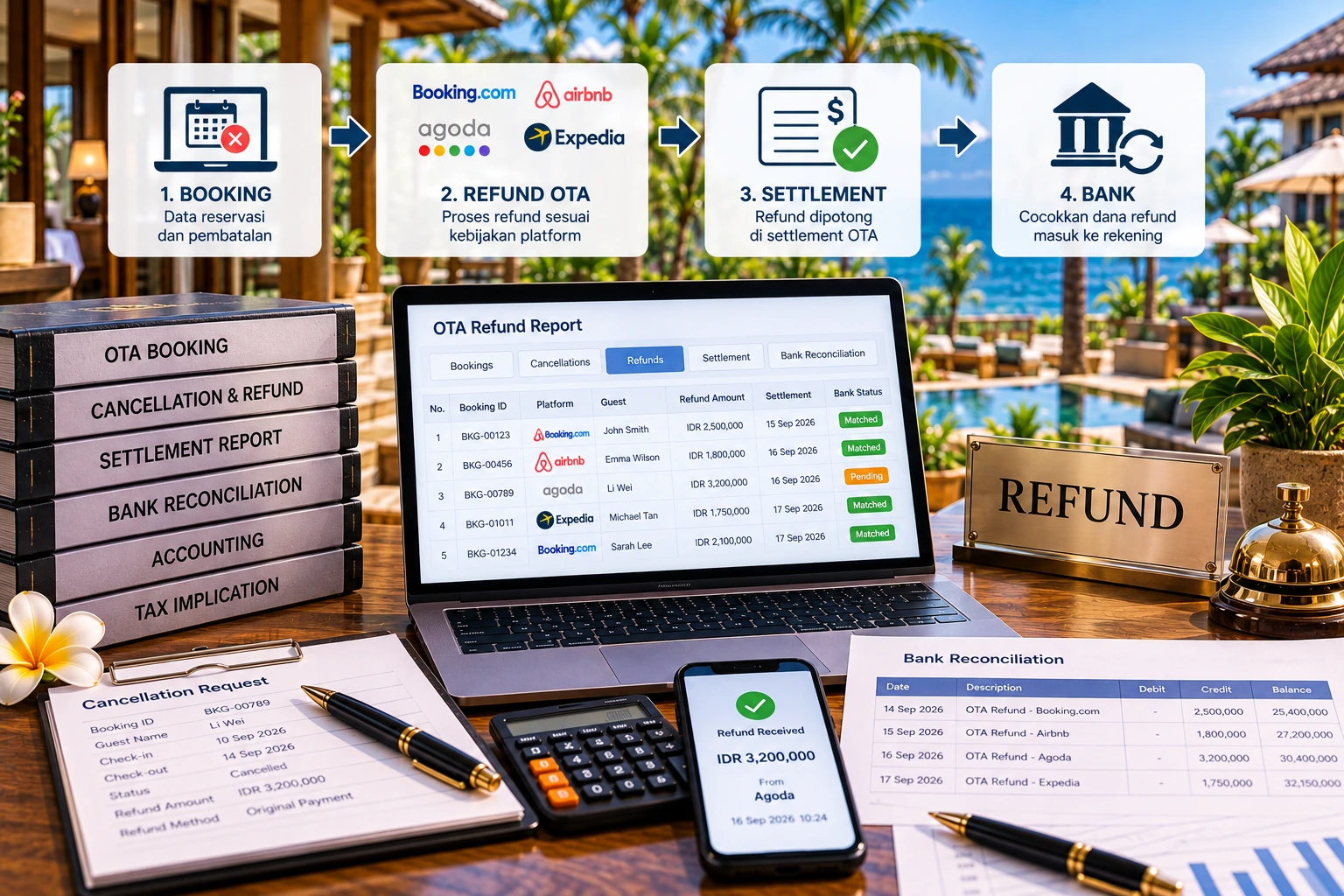
Hotel OTA refunds require more than a negative figure in the monthly report. Finance must show which booking changed, its initial value, the amount refunded, when it was processed, how the OTA changed settlement, and when cash actually left or was offset.
If that connection breaks, gross bookings, OTA reports, bank records and the general ledger can show different figures without adequate explanation.
Hotel OTA Refunds Start with the Original Booking
Trace each refund to its original reservation or booking ID. Without this link, finance sees only cash leaving or a settlement deduction without knowing which guest transaction was corrected.
Retain at least:
- Reservation ID.
- Original OTA or channel.
- Booking date.
- Stay dates.
- Initial booking value.
- Cancellation or change date.
- Refund amount.
- Refund processing date.
- Settlement reference.
- Date cash left or settlement was reduced.
- General ledger posting.
Distinguish full refunds, partial refunds and non-refundable cancellations
Do not assume every cancellation produces the same refund.
For internal controls, separate at least:
- Full refunds.
- Partial refunds.
- Cancellations without refunds.
- Reservation changes with adjustments.
- OTA settlement corrections.
These are not regulatory classifications. They help finance identify what actually changed.
Separate cancellation, refund and settlement dates
One refund can span several periods. A booking may be made in one month, cancelled in the next, and refunded or reflected in settlement several days later.
Do not use one date for the entire process.
Separate booking, cancellation, refund, settlement and cash dates so cross-period variances can be explained.
Why Do Refunds Make Gross Bookings and Settlements Differ?
Gross booking shows the transaction before particular refunds or adjustments. Settlement reflects the platform’s processing according to the relevant documents and period.
A refund can therefore produce several situations:
- The original gross booking remains on reservation reports.
- The refund appears as a separate correction.
- Expected settlement decreases.
- The OTA adjusts the next payout.
- Funds already received must be returned.
- Cash does not move on the booking correction date.
These differences do not automatically mean an accounting error. Finance needs a bridge explaining the movement from original booking to final balance.
The Refund Bridge from OTA to Bank
Use this sequence:
- Find the original reservation ID.
- Obtain the pre-refund booking value.
- Check cancellation or change status.
- Identify the approved refund.
- Check OTA report adjustments.
- Determine expected settlement after refund.
- Check whether the OTA reduces a payout or requests a separate repayment.
- Match settlement to the bank account.
- Match transaction changes to the general ledger.
- Assign statuses to unresolved variances.
The refund bridge is:
Original booking → cancellation/change → refund → OTA adjustment → expected settlement → bank → general ledger.
This is a reconciliation tool to adapt to the OTA’s payment mechanism.
Hotel OTA Refund Decision Matrix
The following table summarises comparisons before choosing the next action.
| Situation | Possible Position | Documents to Check | Action |
|---|---|---|---|
| Cancelled booking with full refund. | The reservation value is fully corrected. | Booking details and refund records. | Match settlement and bank. |
| Partial refund. | Part of the booking value remains. | Booking details and adjustments. | Separate retained and refunded amounts. |
| Cancellation without refund. | Cash or payment entitlement may differ from the original booking. | Rate policy and settlement. | Do not record a refund where none occurred. |
| Refund recorded but bank unchanged. | Timing difference. | Refund reference and bank. | Monitor until cash or settlement changes. |
| Bank changes but OTA report does not match. | Cut-off or incomplete documents. | Settlement statements. | Trace the period and reference. |
| GL differs from bank and OTA. | Posting or account error. | Entries and mapping. | Check accounting postings. |
This is an internal control rather than a mandatory regulatory format.
Example OTA Refund Reconciliation
Suppose an initial booking is IDR 8,000,000. After a reservation change, an approved refund of IDR 2,000,000 leaves IDR 6,000,000 before other settlement components.
The working paper can show:
| Component | Amount |
|---|---|
| Initial booking | IDR 8,000,000 |
| Refund | IDR 2,000,000 |
| Value after refund | IDR 6,000,000 |
| Expected settlement after other OTA components | xxx |
| Actual settlement | xxx |
| Bank | xxx |
| Variance | xxx |
This is only a reconciliation illustration. Actual settlement follows the relevant OTA’s fees, adjustments, payment mechanism and documents.
If the IDR 2,000,000 refund appears in the OTA report while the bank is unchanged, label it a timing difference rather than immediately creating a balancing entry.
Posting Refunds to the General Ledger
No single journal entry suits every OTA refund because transaction structures, recognition timing, payment recipients and settlement mechanisms differ.
Before posting, establish:
- The original booking.
- The transaction value before correction.
- The refund amount.
- Whether cash was previously received.
- Whether the refund is paid directly or offset in settlement.
- The accounts used for the original transaction.
- The transaction and refund periods.
The aim is to maintain an audit trail. Opening a refund entry should immediately identify the reservation and supporting documents.
OTA Refunds and Tax Reporting
Refunds may affect reporting data, but actual treatment should not be inferred solely from cash outflows or reduced settlements.
For local taxes, Government Regulation 35 of 2023 remains listed as effective from 16 June 2023, providing the General Provisions on Local Taxes and Levies framework.
Local regulations, transaction facts and business structures also affect hotel and villa transactions. Reconcile refunds before using correction figures in tax working papers.
Do not assume the refund date, accounting correction date and tax period are identical without reviewing documents and applicable rules.
Documents to Prepare
For a hotel OTA refund review, prepare:
- Booking or reservation reports.
- Reservation IDs.
- Cancellation details.
- Refund confirmations.
- Settlement statements.
- Commission or fee statements, where relevant.
- Adjustment reports.
- Payout references.
- PMS or reservation system records.
- Bank accounts.
- The general ledger.
- Correction entries.
- Related tax working papers.
Use documents from the same period and the following period if refund settlements cross month-end.
When Do OTA Refunds Need Deeper Review?
Further review is relevant when:
- Refunds lack clear reservation IDs.
- Refund amounts differ between the PMS and OTA.
- Cancellations have occurred but adjustments are absent.
- Settlements change without explanation.
- Refunds are processed but bank records remain unchanged.
- Bank cash outflows do not match the OTA.
- Refunds are recorded twice.
- Prior-period refunds remain current-month variances.
- The ledger differs from settlement.
- Refund data is used for tax reports without a reconciliation trail.
Do not immediately erase variances. Identify the last point that still matches, then trace the process after it.
Conclusion
Treat hotel OTA refunds as a transaction sequence rather than merely a negative figure.
Start with the reservation ID, match the initial booking value, identify the cancellation or change, verify the refund, check OTA adjustments and connect expected settlement to the bank and general ledger.
Use original booking → refund → OTA adjustment → settlement → bank → general ledger and assign every difference a status.
This lets finance distinguish genuine refunds, timing differences, incomplete settlements and posting errors before they carry into the next period.
Are OTA Refunds Still Causing Settlement or Bank Differences?
If refunds, cancellations, OTA settlements, bank accounts and the ledger cannot be connected using the same reservation ID, start with the original booking and build a refund bridge through completion.
Usman Tax supports tax and accounting for Bali hospitality businesses. Discuss OTA refund reconciliation, transaction recording and tax reporting through its accounting consultation services.
To continue the review, read the difference between gross bookings and net OTA settlements so documents and next steps fit the issue under discussion.
Read Also: Hotel and Villa Accounting: A Hospitality Finance Systems Guide
Prepare relevant documents before discussing your needs through accounting services at Usman Tax.
FAQ Hotel OTA Refunds
What is a hotel OTA refund in accounting?
It is a correction or repayment of reservation transaction value traceable through the original booking, change or cancellation, OTA settlement, bank account and general ledger.
Does every cancellation produce a refund?
Not always. It depends on rate terms, contracts and actual transactions. Keep cancellation and refund statuses separately.
Why is an OTA refund not yet visible in the bank?
Refund processing, settlement changes and cash movement may occur at different times. Check refund references, settlement statements and payment periods before concluding an error occurred.
Can refunds be deducted directly from gross bookings?
For reconciliation, show refunds separately so gross bookings and corrections remain traceable. Final accounting treatment follows transaction facts and company policies.
Does an OTA refund automatically reduce tax in the same period?
Do not assume so. Examine transactions, dates, documents, tax types and applicable rules before determining tax working paper effects.
What documents matter most for refund reconciliation?
At minimum, reservation IDs, booking details, cancellation or refund confirmations, settlement statements, adjustment reports, bank accounts and the general ledger.
Sources and References
- General Provisions on Local Taxes and Levies — jdih.kemenkeu.go.id
- Criteria and Details of Hospitality Services Not Subject to VAT — jdih.kemenkeu.go.id
Recommended Next Articles
- Comparing Direct Booking and OTA from Gross Bookings to Settlement — usmantax.co.id
- Hotel and Villa OTA Commission Tax — usmantax.co.id
- Hotel Tax Audits and OTA Data Reconciliation — usmantax.co.id