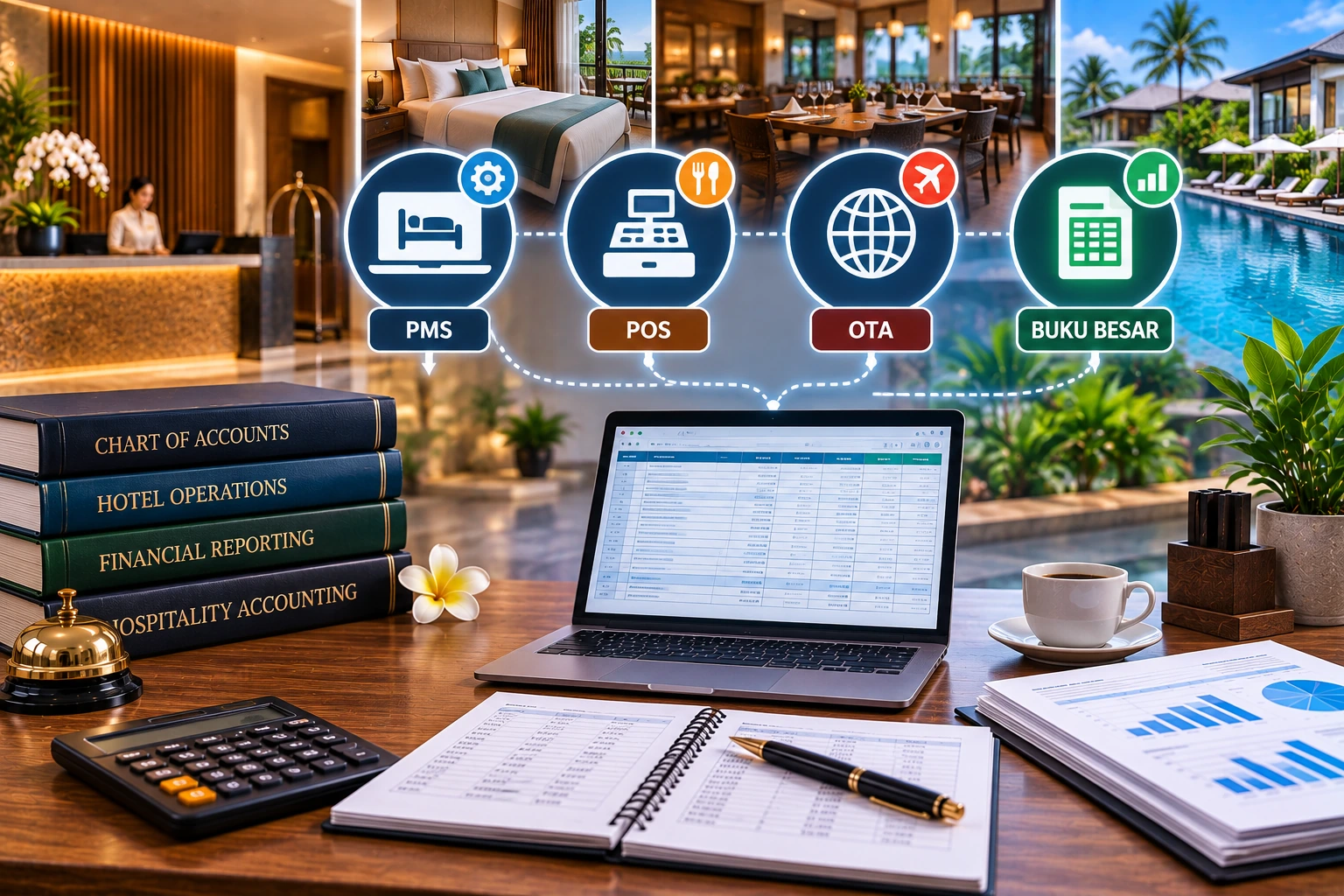



Hotel Account Mapping and Codes for PMS, POS, OTA and the General Ledger
Main topic: Mapping PMS, POS and OTA account codes to the general ledger and controlling code changes.
Full background: Hotel and Villa Accounting: A Practical Finance Guide.
Continue according to your needs: Hotel Chart of Accounts: Designing a Useful Structure and OTA Reconciliation for Hotels and Villas: Booking to Ledger.
Support is available through our hospitality bookkeeping and accounting service.
Hotel account mapping connects the numbers or identifiers used to classify transactions with general ledger accounts. There is no single internal numbering list that every hotel must use. What matters is consistent numbering logic, so PMS, POS, OTA, bank and accounting system transactions can be mapped to the same accounts from month to month.
As an industry reference, HFTP identifies 1 January 2026 as the effective date of the USALI 12th Revised Edition. It also explains that USALI standardisation helps compare a property’s financial position and operating performance with similar properties.
USALI can serve as a hospitality reporting classification reference, but the account numbers in this article are internal design examples. Adapt them to the hotel’s systems, size, departmental structure and reporting needs.
Because the sample structure also includes a Taxes Payable account, it is useful to distinguish the local tax framework from account numbering. Law 1 of 2022 on Financial Relations between Central and Local Governments took effect on 5 January 2022; the Ministry of Finance JDIH record provides its regulatory status.
For implementation, Government Regulation 35 of 2023 on General Provisions for Local Taxes and Levies took effect on 16 June 2023 and repealed Government Regulations 55 of 2016, 10 of 2021 and 97 of 2012. Neither regulation prescribes the hotel account numbers below. Tax objects, bases, rates and administration follow the applicable transaction and location rules.
Hotel Account Mapping: Start with the Logic, Not the Numbers
A frequent mistake is choosing account numbers before defining each account’s function.
A more practical sequence is:
- identify transaction groups;
- determine whether a transaction needs a separate account;
- determine whether additional detail can be stored as a dimension;
- create numbering ranges;
- map each source system to general ledger accounts; and
- test the result through monthly reconciliation.
This approach avoids creating a new account merely because a transaction comes from a different channel, outlet or property.
Distinguish Accounts, Subaccounts and Dimensions
Use three levels of information:
- Main accounts for economically different transaction types, such as Cash, Room Revenue, Guest Deposits or OTA Commissions.
- Subaccounts where management needs a separate reporting balance, such as OTA Receivables and Corporate Receivables.
- Dimensions for information such as department, channel, property or cost centre.
For example, a hotel does not necessarily need 4101 Airbnb Room Revenue, 4102 Booking.com Room Revenue and 4103 Agoda Room Revenue. One Room Revenue account can use different channel dimensions where the system supports them.
Leave Numbering Space for Growth
Code ranges should leave room for new accounts without renumbering every existing account. This is a simple example:
| Group | Example Range |
|---|---|
| Assets | 1000–1999 |
| Liabilities | 2000–2999 |
| Equity | 3000–3999 |
| Revenue | 4000–4999 |
| Direct costs | 5000–5999 |
| Operating expenses | 6000–6999 |
| Other income and expenses | 7000–7999 |
These are internal examples. A hotel may use four, five or more digits if the logic and documentation remain consistent.
Examples of Hotel Account Codes
The following table is a starting point for an account code list, to be adapted to each hotel’s needs.
| Code | Account Name | Function |
|---|---|---|
| 1100 | Cash and Bank | Cash and bank account balances |
| 1200 | OTA Receivables | Amounts not yet settled by OTAs |
| 1210 | Corporate Receivables | Amounts due from corporate customers |
| 1300 | Food and Beverage Inventory | Inventory for food and beverage outlets |
| 2100 | Trade Payables | Liabilities to suppliers |
| 2200 | Guest Deposits | Outstanding deposits |
| 2300 | Taxes Payable | Recorded tax liabilities |
| 4100 | Room Revenue | Revenue from room operations |
| 4200 | Food and Beverage Revenue | Revenue from restaurants and similar outlets |
| 4300 | Spa Revenue | Revenue from spa services |
| 4400 | Other Operating Revenue | Other operating revenue requiring separate identification |
| 5100 | Direct Room Costs | Direct costs of the rooms department |
| 5200 | Food and Beverage Cost of Sales | Food and beverage ingredient costs |
| 6100 | Salaries and Benefits | Labour costs |
| 6200 | Housekeeping | Housekeeping costs |
| 6300 | Maintenance | Property maintenance costs |
| 6400 | Utilities | Electricity, water and other utilities |
| 6500 | Sales and Marketing | Marketing costs |
| 6600 | OTA Commissions | Platform commission costs |
| 6700 | Administration | General administration costs |
This is not a mandatory template. A hotel with banqueting, several restaurants, a large spa, transport or other operations may add subaccounts according to reporting needs.
Mapping PMS Transactions to General Ledger Account Codes
The PMS should not send all room-related transactions to one account without distinguishing their nature.
A minimum mapping can follow this logic:
| PMS Transaction | Example General Ledger Account |
|---|---|
| Room revenue | 4100 Room Revenue |
| Guest deposit | 2200 Guest Deposits |
| Corporate receivable | 1210 Corporate Receivables |
| OTA receivable | 1200 OTA Receivables |
| Refund | The original account or an adjustment account according to policy |
| Cash payment | 1100 Cash |
| Card/bank payment | 1100 Cash and Bank or a payment clearing account |
The purpose is to give the same transaction type consistent account treatment every period. If the PMS has dozens of transaction codes, document the link from each code to one approved general ledger account.
POS Mapping for Restaurants, Minibars and Outlets
POS needs separate mapping from PMS so that outlet transactions do not all enter Room Revenue.
Use this example as an initial control:
| POS Source | Example Account |
|---|---|
| Restaurant | 4200 Food and Beverage Revenue |
| Minibar | 4200 or a minibar subaccount |
| Banquet | A banquet revenue subaccount if material |
| Spa | 4300 Spa Revenue |
| Outlet discount | A contra-revenue account according to policy |
| Food/beverage cost of sales | 5200 Food and Beverage Cost of Sales |
POS and general ledger codes do not need to be identical. However, a stable mapping table is necessary to reconcile outlet reports with the ledger.
Mapping OTA Transactions, Settlements and Bank Accounts
OTAs need particular attention because booking values can differ from amounts received in the bank.
The Usman Tax OTA reconciliation guide uses PMS data, OTA reports, settlements, bank statements and the ledger, mapping reservation IDs, payout references, bank references and journal numbers.
The account flow can be structured as:
Room Revenue → OTA receivable/clearing account → OTA Commissions → Refunds or Adjustments → Settlement → Bank.
If one payout contains many reservations, do not create an account code for each payout. Use the settlement reference to identify the transaction and retain the same account codes.
Do Not Create an Account Code for Every OTA
Airbnb, Booking.com, Agoda and other channels can be distinguished more efficiently through channel dimensions where the software supports them.
For example:
- account: 1200 OTA Receivables;
- channel dimension: Booking.com;
- property dimension: Hotel A; and
- reservation ID: ABC123.
This structure allows reporting by channel without making the chart of accounts unnecessarily long.
Rules for Changing and Adding Account Codes
Account codes should not change merely because a department or operator changes its name.
Before adding an account, ask:
- does the transaction have a different economic nature?
- does management need a separate balance or report?
- can the transaction be distinguished through dimensions?
- does an existing account already perform the same function?
- will the change interrupt reporting history?
If an old account must be replaced, document the effective date and replacement account. Avoid reusing an old number for a transaction with a different meaning, which can confuse historical comparisons.
Checklist Before Using the Account Codes
Before applying the structure to PMS, POS or accounting software, check that:
- every account code has a clear name and function;
- two accounts do not duplicate a function without a reason;
- all PMS transaction codes have a destination account;
- all POS sales codes have been mapped;
- OTA, settlement, commission and refund accounts can be reconciled;
- guest deposits are separated from revenue until recognition conditions are met;
- department, channel and property dimensions have been agreed;
- account codes in monthly reports match those in the general ledger; and
- account changes have version records and effective dates.
This is an internal control checklist and can be adapted to the hotel’s system.
For implementation support, Usman Tax’s accounting services cover bookkeeping and transaction recording, financial statement preparation, and financial analysis and consultation.
Conclusion
Hotel account codes do not need to be complicated, but they must be consistent. Begin with clear account groups, leave numbering space for growth and use dimensions to distinguish departments, channels and properties without creating excessive accounts.
Implementation depends on mapping: PMS transaction codes, POS codes, OTA transactions, settlements, bank records and ledger journals need traceable relationships. This makes reconciliation and monthly closing easier to review without changing the chart of accounts whenever a system or sales channel is added.
Is Hotel Account Mapping Difficult Across PMS, POS and the General Ledger?
If PMS, POS, OTA, bank and accounting systems still use different names or codes without clear mapping, organise the account structure before the issue carries into reconciliation and monthly reports.
Usman Tax provides accounting services for hotels and villas in Bali. A consultation can address account code structure, transaction mapping, reconciliation and reporting needs based on the systems your business uses.
Read Also: Hotel and Villa Accounting: A Practical Finance Guide
FAQ Hotel Account Mapping for PMS, POS, OTA and the General Ledger
Are There Mandatory Account Codes Every Hotel Must Use?
The sources used in this article do not prescribe one internal numbering list for every hotel. Hotels can design their account numbers if the structure, functions and mapping remain consistent.
Does Every OTA Need a Different Account Code?
Not necessarily. If the software supports channel dimensions, several OTAs can share a receivable or clearing account and be distinguished by channel and transaction references.
What Is the Difference Between an Account Code and a PMS Transaction Code?
A PMS transaction code identifies a transaction in the operational system, while an account code identifies a general ledger account. They can differ but need a consistent mapping table.
Do Guest Deposits Need a Separate Account Code?
In practice, deposits should be distinguishable from revenue so balances and transaction status can be traced. The account and recognition policy should align with the company’s accounting policies.
When Should a Hotel Create a New Subaccount?
A subaccount is useful where transactions have materially different characteristics or reporting needs that cannot adequately be distinguished using dimensions.
What If the Existing Account Codes Are Disorganised?
Map old accounts to the new structure, set an effective date, document replacement accounts and avoid reusing an old code for transactions with a different function.
Sources and References
- HFTP Guidance on the USALI 12th Revised Edition — academy.hftp.org
- Law 1 of 2022 on Financial Relations between Central and Local Governments: Status Record — jdih.kemenkeu.go.id
- Government Regulation 35 of 2023 on General Provisions for Local Taxes and Levies: Status Record — jdih.kemenkeu.go.id
- Usman Tax Accounting Services in Bali — usmantax.co.id
- Usman Tax Hotel and Villa Accounting Guide — usmantax.co.id
- Usman Tax OTA Reconciliation Guide for Hotels and Villas — usmantax.co.id
Recommended Next Articles
- Accounting systems for hotels and villas in Bali — usmantax.co.id
- OTA reconciliation for hotels and villas from booking to bank — usmantax.co.id