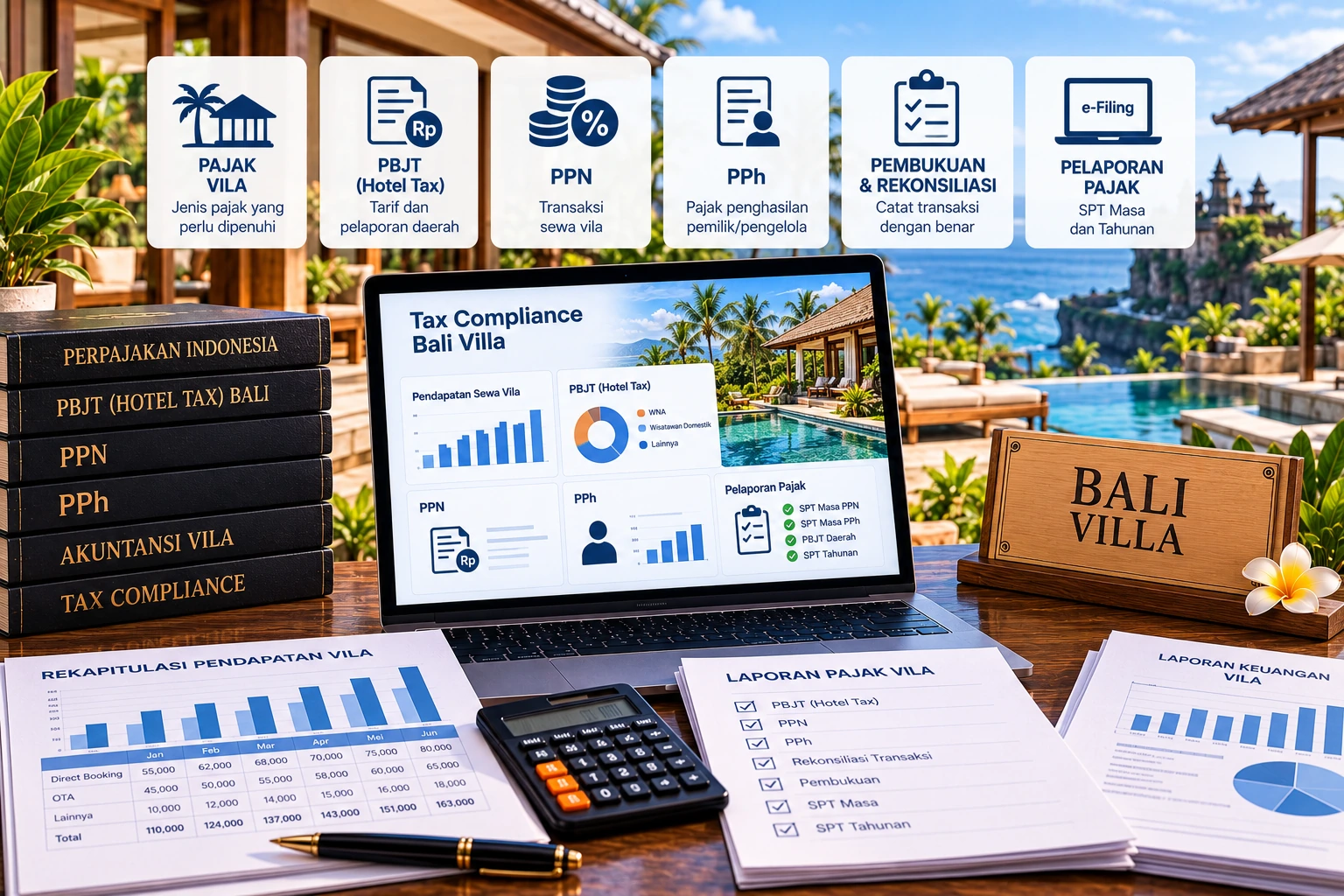



Bali Villa Tax Compliance: A Guide for Owners and Operators
Bali villa tax compliance is the process of ensuring that villa rental and management activities in Bali are classified, recorded and reviewed under the appropriate tax obligations. Checking that tax has been paid is only part of the review. Owners and managers also need to identify who earns the income, how transactions are calculated and whether records support the submitted reports.
This matters particularly when a villa involves investors, the building owner, a management company, booking platforms and different accounts receiving funds.
What Should a Villa Tax Compliance Review Cover?
A villa compliance review connects operating activities, transaction documents, financial records and the taxes that may apply.
Five practical starting questions are:
- Who legally supplies accommodation to guests?
- Who earns the reservation income?
- Is the transaction lodging provision or building rental?
- Does revenue agree with payment records and platform reports?
- Are tax payments and reporting based on traceable amounts and periods?
The answers affect the documents to review and the tax relationships between the parties.
Under Law No. 1 of 2022, PBJT forms part of the local tax framework relevant to accommodation provision.
Villa activity reviews therefore need to consider the rules of the regency or city where accommodation is supplied. Do not assume that every local tax administration procedure in Bali is identical.
Identifying the Parties Responsible for Villa Transactions
Property ownership and operating an accommodation business are different roles. A villa may be owned by an individual, operated by a company and marketed through several platforms.
To avoid incorrect conclusions, follow the actual legal relationships and business activities.
Villas operated directly by their owners
In this model, the owner may handle reservations, set prices, receive payments and manage guest requirements directly.
Important documents include the business operator’s identity, booking records, billing details, payment evidence and bookkeeping.
A key review point is consistency between the party selling the service to guests and the party reporting the income.
Villas operated by management companies
This model involves separate asset owners and operators. A management company may handle marketing, guest services, maintenance and receipts under the contract.
At least three elements need separation: guest revenue, the owner’s contractual entitlement and the management service fee.
| Element | Review Question |
|---|---|
| Property ownership | Who owns the asset or holds its usage rights? |
| Accommodation provider | Who contracts with guests? |
| Payment recipient | To whose account are reservation payments sent? |
| Business income | Which party is entitled to recognise the revenue? |
| Management services | Is there a separate operator fee? |
| Tax administration | Which party has the obligation under the relevant rules? |
The account receiving money does not necessarily establish entitlement to all that income. Cooperation agreements and transaction substance remain the review basis.
Taxes That Need Review
PBJT on hospitality services
PBJT is one aspect to review when a villa provides accommodation to guests.
The review covers more than the tax amount. Owners or operators also need to trace service classification, the service provider, payment components and local administrative rules.
Government Regulation No. 35 of 2023 on the Ministry of Finance JDIH sets out general local tax and levy provisions. Its current status must be checked before using it for technical procedures; the legal portal lists it as effective from 16 June 2023 until revoked at this translation’s review.
For operational application, use the official rules of the local government responsible for the villa’s location. Check amendments and implementing rules before determining rates, tax periods or filing deadlines.
Income tax on villa income and payments to others
Income tax treatment depends on the income source and relationships between the parties.
For example, an operator’s income from supplying lodging can differ in character from payments an owner receives for renting a building to that operator.
Under Government Regulation No. 34 of 2017, lodging services and their accommodation are excluded from the scope of final income tax on land and building rental.
Final income tax on building rental should therefore not automatically be applied to all villa guest payments.
Payments to management companies, property owners or other service providers also need separate review according to transaction characteristics and the applicable tax rules.
VAT treatment of villa services
PBJT and VAT are separate taxes.
Article 6 of PMK 70/PMK.03/2022 includes villa room rental within specified hospitality services that are not subject to VAT.
Apply this provision according to the services actually supplied. If a villa operator also conducts transactions outside lodging services meeting the criteria, determine their treatment separately.
The VAT exclusion for specified hospitality services does not mean that all villa business income is free of tax obligations.
Reconciling Revenue and Booking Transactions
An important part of compliance review is ensuring that reservation figures, accounting records and bank receipts can be reconciled.
Booking platforms may record transactions before commission deductions or after particular adjustments. A net payment report therefore does not always show the full transaction value requiring analysis.
The following figures illustrate reconciliation only. They are not market values, tax rates or an established tax base.
| Transaction Component | Illustrative Amount |
|---|---|
| Initial booking value | IDR 20,000,000 |
| Guest refund | IDR 2,000,000 |
| Value after refund | IDR 18,000,000 |
| Platform fee | IDR 2,700,000 |
| Net payment to the bank account | IDR 15,300,000 |
In this illustration, the difference between the booking value after refund and the bank receipt relates to the platform fee.
However, IDR 18,000,000 should not immediately be treated as the base for every tax. First analyse the transaction components and applicable rules.
A useful review matches the reservation number, stay dates, billing details, refunds, platform fees, bank receipts and general ledger entries.
If management receives funds on the owner’s behalf, also show the owner’s entitlement, the manager’s fee and other contractual obligations.
A Compliance Document Checklist
Complete documents make errors easier to trace when reservation reports differ from bookkeeping or tax reports.
| Document | Review Purpose |
|---|---|
| Identity and business structure documents | Identify the business operator and relevant parties |
| Owner-operator agreement | Determine the management relationship and allocation of entitlements |
| Reservation reports | Trace guest transactions and stay periods |
| Invoices or payment details | Review bill components |
| Platform payment reports | Match reservation values, fees and adjustments |
| Bank movements | Ensure fund flows are traceable |
| General ledger and financial statements | Review revenue and expense recording |
| Tax payment and filing evidence | Compare reports with the relevant transactions |
| Applicable local tax rules | Check administration according to the villa’s location |
Use this summary as an initial guide, then adapt it to the facts and documents of each case.
Cross-Checks Before Reporting
Cross-checks can follow a simple sequence.
First, define the transactions and period under review. Second, identify the service provider and income recipient. Third, match operational transactions to financial reports. Fourth, identify relevant tax categories using official sources. Finally, compare payment and reporting with supporting documents.
If a difference is found, investigate its cause before correcting it. Differences can arise from unsettled transactions, refunds, recording errors or the timing of payment receipts.
When Should Villa Owners Prioritise Further Review?
Further review is particularly relevant after a change of operator, revised revenue sharing contract, use of another party’s bank account, a move from rental to daily accommodation, or discrepancies between reservation and tax reports.
Business structure changes also need review because the relationships between owner, operator and payment recipient can affect transaction classification.
To trace booking and receipt differences, use the villa PBJT reconciliation guide from OTA to bank. If funds are divided between an investor and operator, also match villa income sharing documents to each party’s contractual entitlement.
Conclusion
Bali villa tax compliance should be built on identifying the parties, classifying services, reconciling revenue and reviewing the relevant tax rules.
PBJT, income tax and VAT have different scopes. Reviews must follow the villa’s location and actual transactions, with evidence supporting the analysis beyond marketing terms, assumed universal rates or net platform payouts.
Traceable documentation provides an important basis before managers decide on tax payments, reporting or administrative corrections.
Review Your Villa’s Tax Compliance and Bookkeeping
If your villa transactions involve owners, operators, booking platforms or income sharing, document reviews can help identify areas requiring administrative adjustments.
Through Usman Tax, you can discuss villa management tax reporting, hotel tax reporting and accounting services, according to the business structure and available documents.
Use villa management tax reporting services to discuss reservation data, bookkeeping and reporting completeness for your villa’s management model.
Read Also: Villa Tax Reporting in Bali: An Owner and Operator Guide
FAQ Bali Villa Tax Compliance
Does every villa in Bali have the same tax obligations?
No. Obligations depend on business activities, transaction classification, the income recipient and local tax rules for the villa’s location.
Are villa lodging services always subject to VAT?
No. PMK 70/PMK.03/2022 places villa room rental meeting the specified hospitality service criteria among services not subject to VAT. Other transactions must be assessed according to their characteristics.
Is a management company automatically responsible for all villa taxes?
No. Responsibility must be reviewed using the legal relationships, service provider, income recipient and the rules for each tax.
Which documents are most important before reviewing villa taxes?
Key documents include the management agreement, reservation reports, billing details, platform reports, bank movements, bookkeeping and previous tax payment and filing evidence.
Are platform receipts the same as villa revenue?
Not necessarily. Platforms can deduct commissions, refunds or other adjustments. Reconcile the figures before determining the appropriate revenue recording and tax base.
Sources and References
- Law No. 1 of 2022 on Financial Relations between Central and Regional Governments — BPK
- General Local Tax and Levy Provisions: Government Regulation No. 35 of 2023 — Ministry of Finance JDIH
- Criteria for Hospitality Services Not Subject to VAT: PMK 70/PMK.03/2022 — DJP
- Income Tax on Land and Building Rental: Government Regulation No. 34 of 2017 — DJP