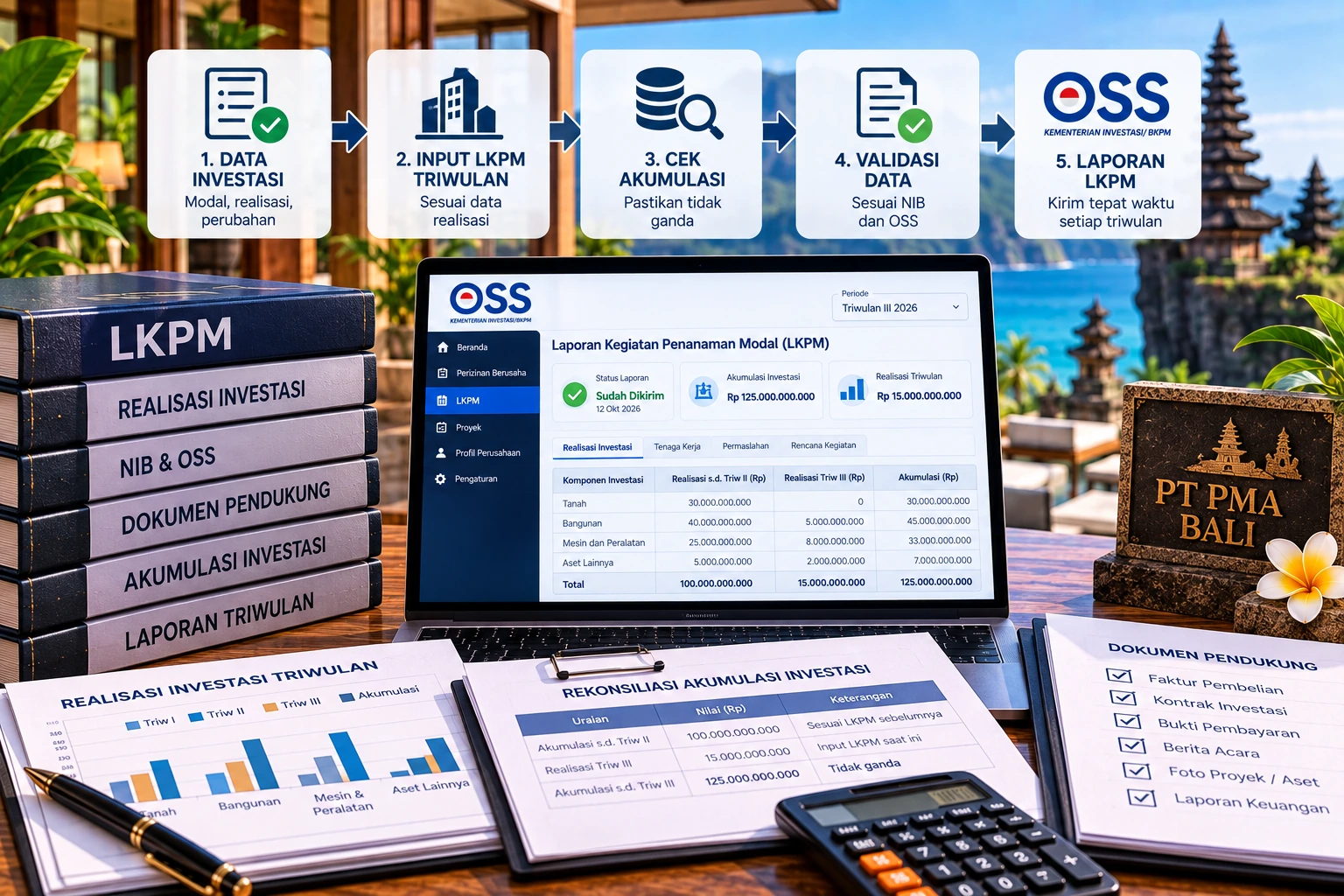



Quarterly LKPM for PT PMA: Preventing Duplicate Investment Totals
Main topic: Controlling investment movements between quarters so additions and cumulative totals are not counted twice.
Complete foundation: PT PMA Tax Obligations in Bali: A Transaction Based Guide.
Continue as needed with PT PMA LKPM Reconciliation: Investment, Assets and OSS Data and PT PMA Tax Document Controls: Calendar, Responsibilities and Filing Evidence.
Assistance is available through business tax consultation services.
Quarterly LKPM for PT PMA can produce an overstated cumulative investment total if the previous period’s total is entered again as new realisation in the next period. Prevent this by separating three figures: the previous cumulative balance, current period additions and earlier investment realisation that has never been reported.
The current LKPM framework is Minister of Investment and Downstream Industry/Head of BKPM Regulation No. 5 of 2025, which is in force and repeals Minister of Investment/Head of BKPM Regulations Nos. 3, 4 and 5 of 2021.
Quarterly LKPM for PT PMA Can Be Duplicated When Additions and Cumulative Totals Are Confused
A simple error is using the company’s total assets as additional investment every quarter.
Suppose cumulative investment at the end of Quarter II is IDR 8 billion. In Quarter III, the company purchases IDR 1 billion of new assets. Quarter III additions are not IDR 9 billion: they are IDR 1 billion, while the updated cumulative total becomes IDR 9 billion if there are no other adjustments.
Additional realisation is a period figure, rather than the old total
For the preparation stage, official instructions define additional investment realisation as the amount realised during the three month reporting period plus realisation before that period which has not yet been reported.
An earlier transaction can therefore appear in current additions if it has never been reported. An asset already reported should not be included again as a new addition.
The cumulative total is the investment balance since the first LKPM
In a separate field, total cumulative investment realisation is calculated from the company’s first LKPM submission through the latest reporting period.
The cumulative balance therefore does not restart from zero every three months.
Use this simple relationship:
Previous closing cumulative balance + additional realisation not previously reported = updated cumulative balance.
This formula is an internal reconciliation tool. Figures entered must still follow the structure and completion rules for LKPM in OSS.
Use a Reconciliation That Rolls Forward Between Quarters
Maintain one working paper that continues from period to period.
| Component | Quarter II | Quarter III Additions | Quarter III Cumulative Total |
|---|---|---|---|
| Land/site preparation | IDR 3,000,000,000 | IDR 0 | IDR 3,000,000,000 |
| Buildings | IDR 3,000,000,000 | IDR 600,000,000 | IDR 3,600,000,000 |
| Equipment | IDR 2,000,000,000 | IDR 400,000,000 | IDR 2,400,000,000 |
| Total | IDR 8,000,000,000 | IDR 1,000,000,000 | IDR 9,000,000,000 |
This example is a mathematical illustration only.
Add further columns for:
- The amount in the previous LKPM
- The amount in the asset register
- The general ledger amount
- Current period investment additions
- Earlier transactions not yet reported
- Classification corrections
- The amount to report
- The difference
- An explanation of the difference
This structure lets finance identify whether cumulative investment increased because of new investment or simply because old amounts were entered again.
Separate Each Business Activity and Location
Article 285 requires businesses to submit LKPM for each business activity and location after obtaining an NIB, subject to the regulation’s applicable requirements and exceptions.
A PT PMA with several activities or locations should therefore reconcile investment beyond the company total alone.
The working paper should identify:
- NIB, the business identification number
- Business Activity Number (NKU)
- KBLI business classification
- Project location
- Activity stage
- LKPM period
Map assets and investment costs to the relevant activity.
If a company has a hotel project in Badung and another activity elsewhere, do not offset the first project’s difference using the second project’s assets.
Who Submits Quarterly LKPM?
For reporting frequency, medium and large businesses submit LKPM every three months, or quarterly.
The regulation also distinguishes preparation stage LKPM for activities not yet operational or conducting commercial transactions from operational or commercial stage LKPM for activities ready for or already conducting commercial transactions.
For Quarter III, Article 286 sets the submission deadline for medium and large businesses at 15 October of the relevant year. Article 286 also provides for official notification adjusting reporting periods that coincide with national holidays.
At the original article’s review, government information sourced from OSS announced a Quarter III 2026 LKPM clinic running from 1 to 15 October 2026.
The original review date was 5 October 2026, when companies with Quarter III obligations were advised to complete reconciliation before finalising their OSS figures. That window is historical by this article’s November publication; check current OSS instructions and the relevant period if a report remains outstanding.
Match LKPM to the Asset Register and General Ledger
Bookkeeping is an important source for testing the figures, but general ledger balances cannot always be transferred directly into LKPM.
Build the following trail:
Invoice/contract → asset register → general ledger account → project/Business Activity Number → first LKPM period in which reported.
Each asset needs a trail showing:
- When it was acquired
- Which project it belongs to
- Its acquisition cost
- The first period in which it was reported
- Whether it is already included in the cumulative balance
The first reported period field is particularly useful for preventing an old asset from appearing as new investment.
Accounting Depreciation Is Different from LKPM Investment Realisation
An accounting asset register may show monthly depreciation. LKPM serves a different investment reporting purpose.
For preparation stage fixed capital, the completion instructions use original acquisition cost and state that reporting investment realisation does not recognise fixed capital depreciation or asset revaluation.
For example, a machine costing IDR 1 billion may have a lower book value after depreciation. That decrease does not mean preparation stage LKPM investment realisation should be reduced by the depreciation amount.
Finance therefore needs to retain two clearly identified bases:
- Acquisition cost for investment reconciliation
- Book value for financial statements
Do not combine them in one column without explanation.
An Example of Reconciling Quarter II to Quarter III
Suppose Quarter II LKPM shows a cumulative balance of IDR 12 billion.
During July–September, the following arise:
- IDR 500 million of new equipment purchases
- IDR 50 million of costs related to asset acquisition
- An IDR 800 million construction invoice
- An IDR 200 million asset from Quarter II found never to have been included in LKPM
The internal working paper can start with:
Quarter II cumulative balance: IDR 12,000,000,000
New Quarter III additions: IDR 1,350,000,000
Earlier realisation not yet reported: IDR 200,000,000
Reconciled cumulative balance: IDR 13,550,000,000
The illustrative figures do not establish that every component automatically qualifies as investment. Each item still needs review against LKPM instructions and project facts.
The key point is that the earlier IDR 12 billion is not entered again as Quarter III additions.
Handling Earlier Investment That Has Never Been Reported
Newly identified historical transactions must be separated from investment already reported.
Use three statuses:
- Already reported: remains in the cumulative balance and must not become an addition again.
- Never reported: assess inclusion under current period instructions.
- Unclear: hold for review until the project, evidence and period can be identified, while managing the reporting deadline.
This is safer than entering every asset register difference in the additional investment field.
If previous cumulative LKPM figures differ from the asset register, locate where the discrepancy began by comparing consecutive reports. Do not correct a historical discrepancy by creating another duplication.
Checks Before Submitting LKPM
Before finalisation, check:
- The selected NIB and Business Activity Number
- Project location
- Preparation or operational stage
- The previous LKPM cumulative balance
- Asset additions during the current three months
- Earlier transactions not yet reported
- Each asset’s acquisition cost
- Invoices or contracts
- General ledger accounts
- The first period in which each asset was reported
- Workforce information and other requested activity data
- Unexplained differences
Do not change figures merely to make totals agree. Every correction needs a transaction basis and a document trail.
When Is Accounting Reconciliation Needed?
More detailed reconciliation is relevant when a company has several projects, a large asset register, OSS cumulative figures that differ from bookkeeping, unclear reporting periods for old assets or changes in project classifications.
In these circumstances, accounting support can include preparing an asset register, mapping accounts, grouping transactions by project and building reconciliation working papers before the data is used for reporting.
Accounting reconciliation does not replace OSS verification or decisions by the investment authority.
Conclusion
Quarterly LKPM for PT PMA is easier to control when each period is treated as a continuation of previous reports.
Maintain a single bridge between periods: previous cumulative balance → current period investment additions → earlier unreported realisation → updated cumulative balance.
Then match each component to its business activity, location, asset register, acquisition cost and general ledger.
This helps identify duplications before figures reach OSS and maintains a consistent investment trail from one quarter to the next.
Does Cumulative LKPM Differ from the Asset Register?
If additions and cumulative totals between quarters are difficult to trace, start with the previous LKPM, then match the asset register, general ledger and new transactions by project.
Usman Tax provides accounting support to organise asset mapping and reconciliation working papers. The results can form an internal basis before the company finalises its reporting data through OSS.
Continue with investment and OSS data reconciliation so the documents and next steps address the issue under review.
Read Also: Business Tax Administration in Bali: Bookkeeping, Reporting and Document Controls
Prepare the relevant documents before discussing your requirements through tax consultation services at Usman Tax.
FAQ Quarterly LKPM for PT PMA
What is the difference between additional realisation and cumulative LKPM?
Additional realisation includes investment in the reporting period plus earlier unreported realisation under the applicable instructions. The cumulative total covers the period from the first LKPM through the latest report.
Should Quarter II investment be entered again as Quarter III additions?
No, if it was already reported in Quarter II. It remains part of the cumulative balance but is not a new Quarter III addition.
What if an asset from an earlier period is found never to have been reported?
Separate it from already reported assets. Preparation stage LKPM instructions allow additional realisation to include earlier unreported investment, but the transaction and supporting evidence must still be reviewed.
Does LKPM follow book value after depreciation?
For preparation stage fixed capital realisation, official instructions use original acquisition cost and state that investment reporting does not recognise fixed capital depreciation or asset revaluation.
When is Quarter III LKPM submitted?
For medium and large businesses, Quarter III is submitted by 15 October of the relevant year.
Is one reconciliation enough for all projects of a PT PMA?
A company total reconciliation can serve as a control, but LKPM obligations must be reviewed by business activity and location. Assets and transactions should therefore first be mapped to the appropriate activity and location.
Does Usman Tax guarantee that OSS will approve LKPM data?
No. The support described here concerns accounting and data reconciliation. Verification, correction requests and reporting status remain matters for the system and relevant authorities.
Sources and References
- Status of Minister of Investment and Downstream Industry/Head of BKPM Regulation No. 5 of 2025 — BKPM JDIH
- Official LKPM Rules, Additional Realisation and Cumulative Investment Instructions — BKPM JDIH
- Government Information on the Quarter III 2026 LKPM Period — Pekalongan DPMPTSP