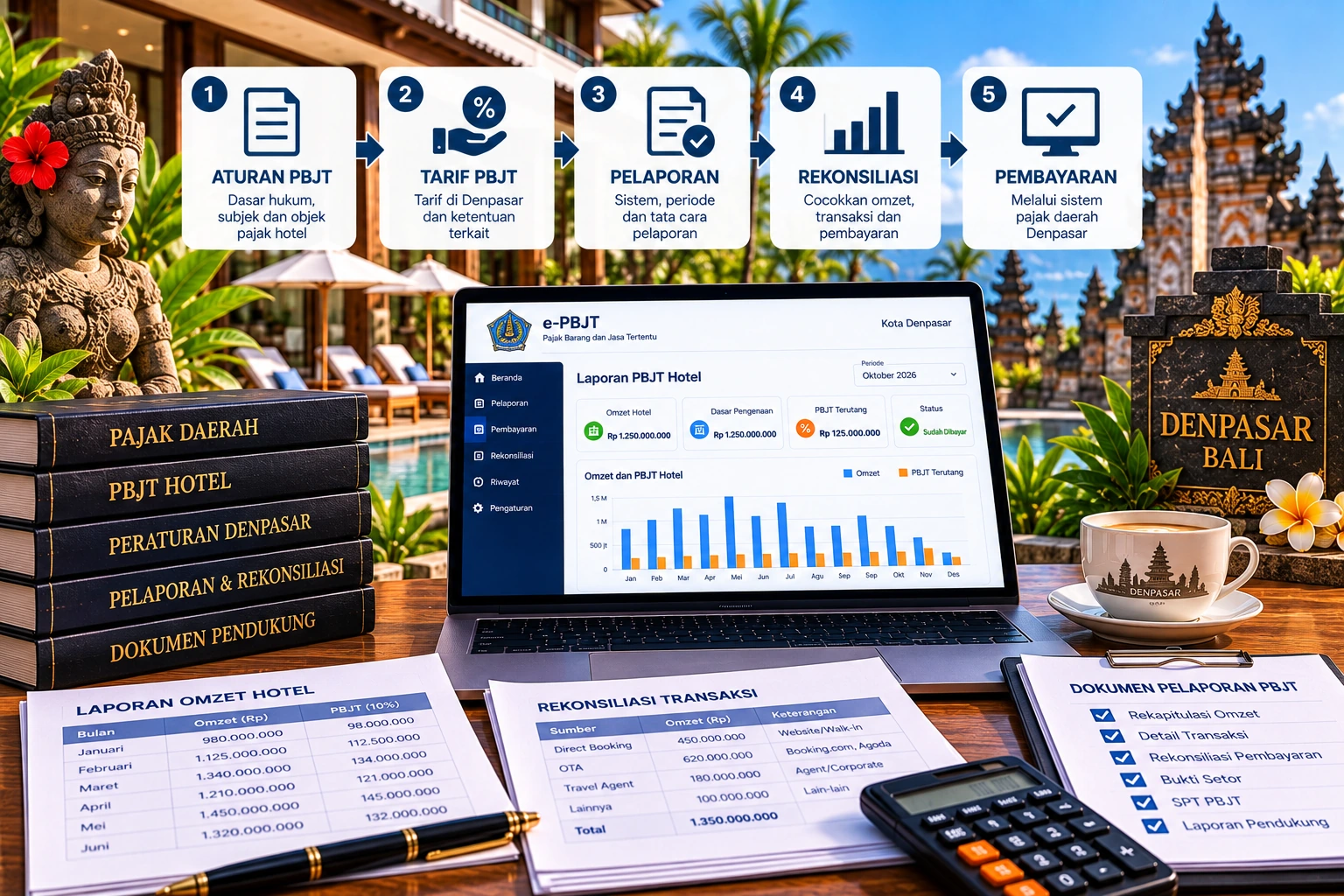



Denpasar Hotel PBJT: Rules, Reporting and Reconciliation
Denpasar hotel PBJT concerns obligations for Tax on Certain Goods and Services relating to hospitality services within Denpasar City. For hotel owners and managers, reviewing compliance requires more than looking at money received in the bank. Revenue data, guest transactions, the tax base, reporting and payment must be checked consistently.
Hotel managers also need to distinguish Denpasar City’s rules from those of other local governments in Bali. Administrative boundaries can affect the relevant regulations, reporting services and deadline information that must be checked.
What Is Hotel PBJT in Denpasar City?
PBJT stands for Pajak Barang dan Jasa Tertentu, or Tax on Certain Goods and Services. For hotels, the main focus is hospitality services within the scope of local tax regulation.
This tax should be understood as part of business compliance management, rather than merely adding an amount to a guest’s bill. A hotel must be able to explain the origin of the revenue figures used to calculate tax and provide appropriate supporting records.
Hotel owners, operational managers, reservations teams and accounting staff should use transaction data traceable to the same sources. This allows reports to be reviewed when questions, corrections or differences arise.
The Regulatory Basis for Denpasar Hotel PBJT
Denpasar’s local tax framework refers to Regional Regulation No. 5 of 2023, as amended by Denpasar City Regional Regulation No. 2 of 2025.
Implementing provisions include Denpasar Mayor Regulation No. 1 of 2024, which is listed as in force in the Audit Board’s regulations database. For 2026 deadline changes, also read Bapenda’s notice referring to Mayor Regulation No. 9 of 2026 amending that implementing regulation.
These regulations must be read together. Amendments should not be ignored when relying on an earlier regulation. Operational requirements must also be checked against implementing regulations and relevant administrative announcements.
How should the applicable rate be checked?
Before fixing the calculation, managers should check the hospitality services PBJT rate provisions in the regional regulation, its amendments and implementing rules. The review should also cover transaction classification and the correct tax base.
This article does not prescribe a rate as a substitute for checking the updated legal text. For transactions requiring a tax decision, use the rules applicable to the relevant tax period and seek clarification where uncertainty remains.
Why does the hotel’s location matter?
A hotel within Denpasar City’s administrative boundaries needs to check Denpasar’s local tax rules. Do not automatically use deadlines, procedures or regulations obtained from Badung Regency or another regency.
Jurisdiction also matters when one company manages properties in several regions. Operational reporting may be centralised, but local tax obligations must be reviewed by location and the applicable rules.
Which Revenue Transactions Need Review?
Begin by identifying the types of transactions the hotel receives. Operational data often includes room revenue, advance payments, refunds, additional transactions and receipts through booking intermediaries.
Figures in a bank statement or reservation system do not automatically have the same tax treatment. Managers must distinguish transaction value, receipt timing, payment nature and the type of service supplied.
| Transaction Group | Suggested Review |
|---|---|
| Room revenue | Match reservation values, charged rates and transaction reports |
| OTA reservations | Check booking values, commissions, deductions and receipts |
| Guest deposits | Trace the payment purpose and when the transaction is treated as revenue |
| Reservation cancellations | Check cancellation status and refund evidence |
| Additional services | Separate by service type and tax classification |
| Transaction corrections | Retain the reasons, approvals and adjustment records |
This table is an internal review tool, rather than a definitive determination of taxable items. Each transaction must still be classified under the applicable rules.
Reconciling Reservations, OTAs and Bank Receipts
Differences between reservation values and bank receipts need to be traced before filing. They may relate to intermediary commissions, refunds, payment settlement timing or transaction recording.
As an internal control before completing the monthly revenue report referred to in Bapenda Denpasar’s service standards, managers should match reservations, operational transactions, bank receipts, cancellations and refunds.
An example of checking an OTA payment
Suppose a hotel records a reservation value of IDR 10,000,000, but receives only IDR 8,500,000 from the booking intermediary after an IDR 1,500,000 commission deduction.
This example shows an IDR 1,500,000 difference between the reservation value and the net receipt. That difference alone does not determine the PBJT base.
Managers must examine who sells the service to the guest, how the commission is recorded, the amount paid for the relevant service and how local tax regulations treat the transaction.
The net bank receipt should therefore not be adopted directly as the reporting figure without further examination.
How to prepare a reconciliation worksheet
For each period, prepare a worksheet containing at least the reservation number, transaction date, booking channel, transaction value, commission, refunds, receipts and explanations of differences.
Connect every difference to supporting evidence. If a reservation remains unresolved, assign a review status so it is separated from completed transactions.
This helps accounting staff trace the reasons for revenue changes before the figures are used in tax reports.
Documents and Reporting through SIMPADA Terpadu
In its PBJT Reporting and Payment Service Standards, Bapenda Denpasar lists the NPWPD card, monthly revenue report, self reporting username and password, and local tax payment code among the documents or access requirements to prepare.
Before reporting, ensure the taxpayer identity is correct, system access remains usable and the revenue report has been checked by the company’s designated reviewer.
An official Bapenda Denpasar notice directs online SPTPD reporting for PBJT, including hospitality services, to SIMPADA Terpadu because the former e-pajak address is no longer used.
Checks before submitting a report
- Determine the tax period to report and collect its transaction data.
- Match operational revenue with reservation reports and accounting records.
- Review classifications affecting the tax base.
- Confirm the taxpayer identity and SIMPADA access.
- Enter data using the reviewed documents.
- Recheck the report summary before submission.
- Archive filing evidence and supporting documents.
If data differs, complete the investigation or document the issue before treating the report as finished.
Denpasar Hotel PBJT Deadlines and Payment
Filing and payment schedules must be checked against the rules and period information issued by the local authority. Managers should not use a date from an old article as the sole basis for their tax calendar.
As an example for a specific period, Bapenda Denpasar set 14 October 2026 as the filing and payment deadline for the September 2026 tax period.
This is the official date for September 2026, rather than an automatic deadline for every subsequent period. Managers need to update the compliance calendar using information applicable to each tax period.
According to Bapenda Denpasar’s service standards, PBJT reporting can be completed online or offline, while payment is available through Bank BPD Bali and digital channels. Its service standards published on 18 August 2026 state a maximum of 10 working days after the end of the tax period for reporting and payment; check the official date for the period concerned.
In its local tax payment information, Bapenda explains that bills can be obtained through SIMPADA Terpadu, with payment using a payment code or QRIS subject to the available channel’s requirements.
After paying, match the amount to the bill, retain transaction evidence and check the completion status in the relevant system.
Mistakes to Avoid
PBJT administration errors do not always start with the rate calculation. Problems also arise when reservations, operations and accounting use inconsistent recording bases.
Watch for bank receipts being used as the sole revenue figure, unreconciled OTA commissions, cancellations without refund evidence and transaction corrections without explanation.
Other administrative risks include using the previous period’s deadline, failing to retain filing evidence or treating payment as complete merely because a transfer instruction has been created.
To reduce these risks, assign responsibility for data review, use a monthly checklist and retain transaction documents with consistent filenames.
For hotels with high transaction volumes, divide the process into data collection, reconciliation, tax review, internal approval, reporting and payment evidence checks.
For detailed use of the reporting channel, continue to the Denpasar PBJT reporting guide through SIMPADA. If the business operates in other regencies or cities, use the Bali hotel PBJT jurisdiction guide (Indonesian) so each property’s administrative references follow its own location.
Conclusion
Denpasar hotel PBJT compliance requires a clear connection between local regulations, revenue data, transaction classification, reporting and payment. Owners need to ensure reported figures can be traced to transaction evidence, including OTA reservations.
The most useful priorities are updating legal references, reconciling revenue each tax period, using official reporting channels, checking deadline information and retaining filing and payment evidence.
If the hotel’s transactions are complex or bookkeeping differs from tax reports, conduct a more detailed review before making tax decisions.
Need Help Reviewing Hotel PBJT Reporting in Denpasar?
Hotel PBJT administration may require reservation data reviews, revenue reconciliation and preparation of tax reports consistent with bookkeeping. Usman Tax provides hotel tax reporting services and accounting services for hospitality businesses in Bali.
Discuss your hotel’s administration and transactions to determine the appropriate scope of review and reporting support.
Discuss data readiness and monthly reconciliation through Usman Tax’s hotel tax reporting services, based on the hotel’s transactions and requirements.
Read Also: Hotel Tax Reporting Documents: A Checklist for Finance Teams
FAQ Denpasar Hotel PBJT
Is hotel PBJT in Denpasar the same as hotel tax in Badung?
Both concern local tax on hospitality services, but they must be checked against the regulations and administration of the government responsible for each location. Do not automatically apply Badung reporting procedures or deadline information to a hotel in Denpasar.
Where do hotels report Denpasar City PBJT?
Bapenda Denpasar directs online SPTPD reporting through SIMPADA Terpadu. Confirm the taxpayer’s access and check Bapenda’s latest instructions before reporting.
Does an OTA commission directly reduce the PBJT base?
This cannot be concluded solely from the difference between the reservation price and bank receipts. Managers must check the commission’s nature, transaction documents, payments for hospitality services and the applicable tax base rules.
Is the Denpasar PBJT due date always the same each month?
Do not assume so without checking the relevant rules and period announcement. For example, Bapenda set 14 October 2026 for the September 2026 tax period. Information must be checked for each period.
What should be done if hotel revenue differs from bank reports?
Trace differences using reservation reports, payment evidence, OTA commissions, cancellations, refunds and accounting journals. Document the causes before determining the figures used in tax reporting.
Sources and References
- Amendment to Denpasar City Regional Regulation No. 5 of 2023 — BPK
- Implementing Regulation for Denpasar City Local Taxes and Levies — BPK
- Denpasar City PBJT Reporting and Payment Service Standards — Bapenda Denpasar
- Notice of the Change to Denpasar’s Local Tax Reporting System — Bapenda Denpasar
- Local Tax Deadline Information for September 2026 — Bapenda Denpasar
- Local Tax Deadlines and Payment Channels — Bapenda Denpasar