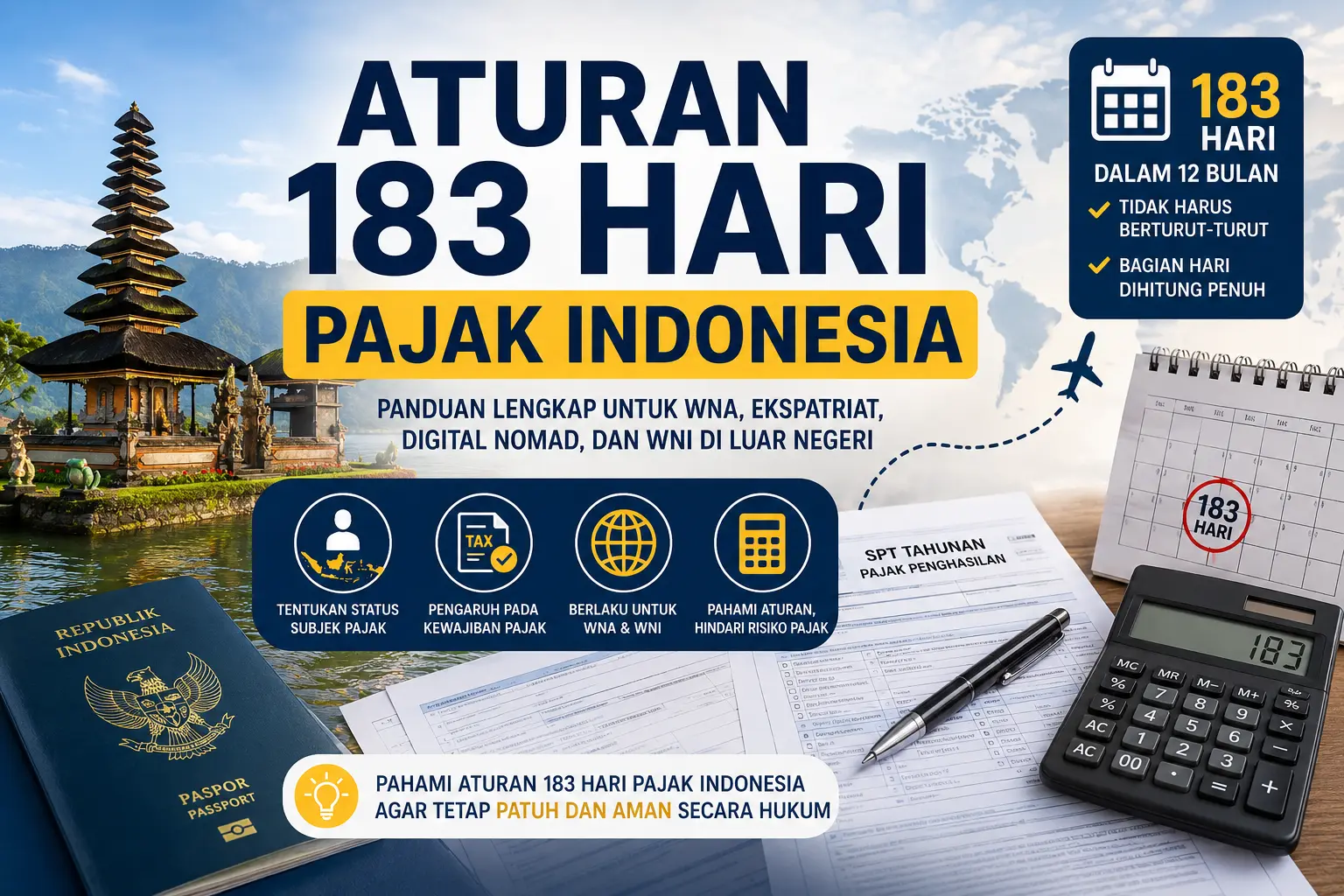



Indonesia 183-Day Tax Rule: Counting Days and Residence
At a glance: The Indonesia 183-day tax rule concerns individual tax residence, assessed alongside residence and intention to reside. It is not a nationality test or a universal exemption for shorter visits. For a broader income overview, see tax for foreigners living in Bali. Our residence intention evidence guide examines supporting documents. Advice is available through tax consultation.
The Indonesia 183-day tax rule is often misunderstood by expatriates, foreign investors, digital nomads, and Indonesians working abroad. Tax residence is more than a simple count of days.
The distinction between a domestic tax subject (SPDN) and a foreign tax subject (SPLN) affects the scope of taxable income, return filing, and possible treaty treatment. The presence test uses a 12-month period rather than necessarily a calendar year, and visits can be continuous or interrupted.
Understanding the rule helps foreign nationals in Indonesia and Indonesians overseas avoid errors when reviewing their obligations.
What Is the Indonesia 183-Day Tax Rule?
The presence test is one route to domestic tax-subject status. Under the current official residence rules, PER-23/PJ/2025, the criteria also address actual residence and intention.
An individual can fall within the domestic criteria by:
- Being present in Indonesia for more than 183 days within 12 months; or
- Being in Indonesia during a tax year and intending to reside there.
Actually residing in Indonesia is a further independent criterion. These alternatives should be read together; intention is not an additional condition that must always be proved after the presence threshold is exceeded.
A person who does not meet the domestic criteria may be a foreign tax subject. Indonesians abroad need to meet the specific conditions relevant to their circumstances, rather than rely on absence alone.
Why Does the Rule Matter?
Domestic and foreign tax subjects have different scopes of Indonesian taxation.
Domestic residents generally need to consider Indonesian and overseas income, subject to applicable exclusions, special provisions, and relief. Foreign tax subjects generally need to consider Indonesian-source income and the rules governing it.
The issue is relevant to:
- Foreign investors.
- KITAS and KITAP holders.
- Digital nomads.
- Expatriates.
- Foreign consultants.
- Remote workers.
- Indonesians working abroad.
- Cross-border business owners.
How Do You Count the Days?
A common mistake is counting only from January to December.
The presence criterion uses a 12-month period. Count physical presence across continuous or separate visits; part of a day counts as a full day under the official rules.
A Calculation Example
Assume a foreign national records:
- January to March: 90 days of actual presence.
- June to August: 60 days of actual presence.
- October to November: 40 days of actual presence.
The total is 190 days within 12 months. These are illustrative recorded visit durations, not the full calendar length of each month range. The total exceeds 183 days and the relevant domestic residence criterion must be addressed, together with any treaty analysis.
Does Exceeding 183 Days Automatically Mean Tax Is Payable?
Distinguish tax-subject residence status from the amount of tax ultimately payable. More than 183 days is itself a domestic residence criterion, while a payment obligation also depends on income and applicable provisions.
Separately, intention to reside can be supported by documents such as:
- A permanent stay permit, KITAP.
- A limited-stay visa, VITAS, valid for more than 183 days.
- A limited-stay permit, ITAS, valid for more than 183 days.
- An employment or business contract for more than 183 days.
- A residential lease exceeding 183 days.
- Evidence of relocating family members to Indonesia.
These documents explain why a shorter presence does not automatically establish nonresidence. Their legal significance should be checked against the current rules and complete facts.
The Rule for Foreign Nationals
Foreign nationals should review residence before beginning work, investment, or business activity in Indonesia.
More than 183 days within 12 months can meet the presence criterion. Residence or qualifying intention may establish domestic status under a different criterion. A person present for no more than 183 days can be foreign-resident only if the other domestic criteria are not met, subject to relevant treaty treatment.
For the income categories that follow from that analysis, see our foreigners’ Bali tax overview.
The Rule for Indonesians Working Abroad
An Indonesian identity card does not by itself resolve tax residence. Physical presence and the other statutory conditions matter.
An Indonesian outside Indonesia for more than 183 days may qualify as a foreign tax subject if the additional substantive and administrative requirements are met. Review foreign residence, relevant documents, and the official procedure for the specific case.
Each conclusion needs evidence rather than an assumption based solely on citizenship or a foreign employment contract.
How KITAS and KITAP Relate to Residence
Stay permits are relevant documents, but do not replace the legal residence assessment or establish the final tax amount on their own.
Factors to review include:
- Time spent in Indonesia.
- The permit’s validity.
- Employment or business contracts.
- An available home.
- Family location.
- The center of economic activity.
Permit holders should assess these facts together with the applicable criteria.
Illustrative Cases
Example 1
An Australian investor spends 210 days in Indonesia within 12 months and runs a business from Bali.
The presence threshold is exceeded. Review domestic status, the relevant income obligations, and any applicable treaty rather than treating intention as an extra prerequisite to the presence test.
Example 2
A digital nomad spends 90 days in Indonesia, then travels elsewhere.
The presence test alone is not met. Residence and intention still need review, and Indonesian-source income may remain relevant even for a foreign tax subject.
Example 3
An Indonesian works in Singapore for three years and meets the requirements for foreign tax-subject status.
The person’s Indonesian obligations can differ from those of an Indonesian domestic resident. The assumed satisfaction of those requirements is essential to this example.
Common Mistakes
- Using only the calendar year instead of the relevant 12-month period.
- Assuming the days must be consecutive.
- Treating a KITAS as the sole answer to every tax question.
- Failing to report or administer a status change.
- Confusing domestic and foreign tax-subject status.
- Ignoring an applicable tax treaty.
These errors can create administrative noncompliance or an incorrect view of the income that must be reported.
Practical Tips
- Maintain a physical-presence record.
- Retain travel documents, stay permits, and employment contracts.
- Review the Directorate General of Taxes’ current rules.
- Check whether a relevant tax treaty applies.
- Seek advice for cross-border circumstances.
Use the documents to support the facts rather than begin with a preferred residence conclusion.
Conclusion
The Indonesia 183-day tax rule is important to the distinction between domestic and foreign tax subjects, but residence and intention are also independent considerations.
Foreign nationals, expatriates, investors, digital nomads, and Indonesians abroad should review their position before work, investment, or relocation decisions. A documented assessment reduces administrative mistakes and helps identify the relevant domestic and treaty obligations.
Read Also: Business Tax Administration in Bali: Bookkeeping, Reporting and Document Controls
FAQ Indonesia 183-Day Tax Rule
1. What does the rule mean?
Presence for more than 183 days in 12 months is one criterion for domestic tax-subject status. Residence and intention provide other criteria.
2. Is the period always January to December?
No. The presence criterion uses a 12-month period.
3. Must the days be consecutive?
No. Separate periods of presence are accumulated within the relevant period.
4. Does a KITAS automatically settle my tax position?
No. Its duration and other facts can be relevant evidence, but residence, income, and reporting must be assessed under the complete rules.
5. Do Indonesians abroad still pay Indonesian tax?
That depends on their domestic or foreign tax-subject status, income, and applicable rules, including any relevant treaty.
6. How can I establish my status?
Review presence, residence and intention evidence, income, and the governing provisions. Cross-border cases merit professional advice.
Need International Tax Advice?
Residence analysis can affect filing, taxable income, and treaty use. A detailed review may be needed for foreign nationals and Indonesians with cross-border activities.
Usman Tax provides international tax consultation, residence analysis, compliance support, return preparation, and assistance for individuals and companies operating in Indonesia.